The Best Day Trips from Tokyo
More than 20 day trips from Tokyo by theme: temples, onsen, hiking, flower parks, the coast and Mount Fuji. Travel times, fares, the best season for each, and which need a night.
From Tokyo you can reach old temple towns, volcanic hot-spring valleys, seaside resorts and famous flower parks in under two hours by train, and the closest, Yokohama, Kawagoe and Mount Takao, are only 30 to 55 minutes away. Which one to pick comes down to what you like and when you are travelling: Kamakura and Nikko for temples, Hakone and Atami for onsen, Mount Takao and Nagatoro for nature, Ashikaga and Hitachi Seaside Park for flowers in season, and Yokohama for food and the waterfront, while Mount Fuji with Lake Kawaguchiko, and Hakone, remain the big scenic days out. A few places sold as day trips are better with a night: Nikko, whose best autumn scenery is up at Lake Chuzenji, Karuizawa, and above all Kusatsu Onsen, three to four hours or more each way. And buy a rail pass only for the route it covers: the JR Tokyo Wide Pass, the Hakone Free Pass, the Enoshima-Kamakura Freepass and the Nikko passes each pay off on specific trips only.
Check Availability
The short version
- Two hours by train is the realistic day-trip radius from Tokyo. Inside that ring sit more than 20 genuine day trips across six themes: temples and old towns, onsen, nature and hiking, seasonal flowers, the coast, and food and shopping.
- The closest and easiest: Yokohama (about 30 minutes), Kawagoe (about 30 minutes from Ikebukuro), Mount Takao (about 50 minutes) and Kamakura (about an hour). They need little planning and suit first-timers, families and half days.
- The big scenic trips: Mount Fuji and Lake Kawaguchiko (about 1 hour 55 minutes direct) and Hakone (about 85 minutes to Hakone-Yumoto). Both have their own detailed guides on this site, listed below.
- Better as an overnight, or accept a long day: Nikko, Karuizawa and Kusatsu Onsen. Nikko works in a day for the shrines but not for its best scenery, and Kusatsu has no station and takes three to four hours or more each way.
- For flower trips, the date is everything. Ashikaga Flower Park’s wisteria peaks from late April to early May; Hitachi Seaside Park’s nemophila peaks in mid to late April and its kochia turns red in mid-October; Chichibu’s shibazakura (moss phlox) runs from mid-April to early May; Nikko’s autumn colour peaks high up in mid to late October and reaches the town by early November; and Kamakura’s hydrangeas peak in mid to late June.
- Crowding is now a real problem in Kamakura, where the railway crossing made famous by the anime Slam Dunk, near Kamakura-Kōkō-Mae Station, draws crowds that spill onto the road; the city has closed vandalised toilets there and turned to crowdfunding to pay for crowd-control staff. Go on a weekday and start early for the popular places.
How to plan a day trip from Tokyo
Tokyo sits at the centre of the Kanto rail network, so a “day trip” can mean anything from a 25-minute hop to Yokohama to a bullet-train run of more than an hour to Karuizawa. Three practical rules:
- Leave early. For anywhere 90 minutes or more away, a 7:00 to 8:00 a.m. departure roughly doubles your useful sightseeing time and beats the tour buses that arrive mid-morning.
- Go on a weekday to the popular places: Kamakura, Hakone, Kawagoe and the flower parks at their peak. Weekend crowds are far heavier.
- Choose the pass to fit the route, not the other way round. A pass saves money only on particular lines, and the wrong one wastes it.
All prices below are the latest published 2026 figures and should be checked before you travel, because fares and flower dates change; several passes were repriced in late 2025 and March 2026.
Mount Fuji and Lake Kawaguchiko (about 1 hour 55 minutes)
The day trip most visitors to Japan have in mind. The direct Fuji Excursion limited express runs from Shinjuku to Kawaguchiko in about 1 hour 54 minutes, at ¥4,200 one way on Fujikyu Railway’s official fare, and it sells out, so book ahead. From Kawaguchiko you can reach the lakeshores, the Chureito Pagoda above Fujiyoshida, the spring-fed ponds at Oshino Hakkai and, when the road is open, the Fuji Subaru Line 5th Station. The one thing no timetable controls is whether the mountain is out: Fuji is fully visible on something like 80 to 100 days a year, and our visibility guide explains how to check on the morning.
Our Mount Fuji day-trip guide compares every way of doing it in a day, our transport guide prices each route, and our guide to the best places to see Mount Fuji sorts the viewpoints. For a day without timetables, the Mount Fuji Private Tour With English Guide picks you up at your Tokyo hotel with a car and driver-guide for the day, at 4.94 stars from 675 reviews and $309 for the vehicle, broken down here. On a budget, the Mt. Fuji, Hakone Ropeway, Owakudani and Lake Ashi coach tour covers Fuji and Hakone in one long day, at 4.65 stars from 8,014 reviews and $54 a person.
Temples and old towns
Kamakura (about 1 hour): the Kyoto of eastern Japan
The former seat of the shoguns, on the coast south of Tokyo, is packed with sights: the Great Buddha at Kotoku-in, the hillside Hasedera temple, Tsurugaoka Hachimangu shrine and the Komachi-dori food street. The quickest way there is the JR Yokosuka Line from Tokyo Station, about an hour. To combine it with Enoshima, the Odakyu Enoshima-Kamakura Freepass (about ¥1,640 from Shinjuku) covers the return trip to Fujisawa and unlimited rides on the scenic Enoden line.
Season: hydrangeas (ajisai) peak from mid to late June. The famous places are Meigetsu-in, “the hydrangea temple”, with about 2,500 blue hydrangeas, and Hasedera, with thousands along its hillside path.
A 2025–26 warning: the Enoden level crossing at Kamakura-Kōkō-Mae Station, made famous by the anime Slam Dunk, has become a flashpoint for overtourism. Up to 200 people gather there at busy times, and Kamakura police logged 124 reports connected with the crossing in the first eight months of 2025, against 18 in the whole of 2022. Expect crowds, and remember it is a residential street.
To see Kamakura and Yokohama in one day without the trains, GetYourGuide sells a Kamakura and Yokohama private day tour taking in the Great Buddha and the coast, at 4.95 stars from 29 reviews, a small number to judge by.
Nikko (about 1 hour 50 minutes): UNESCO shrines in the mountains
Home to the lavishly carved Toshogu Shrine, Futarasan Shrine and Rinno-ji Temple, with Lake Chuzenji and Kegon Falls higher up. The easiest route is the Tobu limited express from Asakusa, about 1 hour 50 minutes, from about ¥3,050 one way. The Nikko World Heritage Area Pass (about ¥3,000 for two days) covers the return trip and the town buses.
Honestly: Nikko works as a day trip for the shrines, but its best scenery, Lake Chuzenji, Kegon Falls and the Irohazaka road, lies up in Okunikko and adds a lot of travel time. Many visitors find the day rushed and wish they had stayed the night.
Season: autumn colour reaches Okunikko around early October, peaks at Lake Chuzenji and Kegon Falls in mid to late October, moves down the winding Irohazaka road in late October and reaches Nikko town by early November. The best colour is up in Okunikko; the town itself is mostly evergreen.
Kawagoe (about 30 minutes): “Little Edo”
A preserved merchant town in Saitama with clay-walled kurazukuri warehouses, the Toki-no-Kane bell tower and Kashiya Yokocho, the “sweets alley”. It is about 30 minutes on the Tobu Tojo Line from Ikebukuro (about ¥490); the Seibu Line to Hon-Kawagoe, closer to the old town, has a discount pass for foreign passport holders (about ¥700). An easy half day, and far less crowded than Kamakura or Nikko, though it is getting busier fast.
Narita (about 75 minutes, or 12 minutes from the airport): a temple town
Naritasan Shinshoji, founded in 940, is one of the busiest places of worship in Japan at New Year, when more than 3 million people come for hatsumode, the first visit of the year. You approach it along the shop-lined Omotesando street, known for grilled eel (unagi). It suits a long airport layover as well as a day trip.
Season: plum blossom in February, cherry blossom from late March to early April (with planes landing behind the petals at Sakura-no-Yama Park), and maples in mid-November.
Sawara (about 90 to 100 minutes): a canal town
A quiet Chiba town of willow-lined canals and Edo-period merchant houses, home of Inoh Tadataka, who made Japan’s first accurate map. Take the JR Sobu Line to Narita, then the Narita Line to Sawara. It is genuinely uncrowded, a good antidote to Kamakura.
Mashiko (2 hours or more): a pottery town
In Tochigi, known for its rustic Mashiko-yaki ceramics, with about 250 kilns and 50 pottery shops and hands-on pottery classes. Take the Tohoku Shinkansen to Utsunomiya (about 50 minutes), then a local connection. Best for people who love crafts.
Onsen and a slower day
Hakone (about 85 minutes to Hakone-Yumoto): the classic onsen loop
The volcanic Owakudani valley, a “pirate ship” across Lake Ashi, art museums, hot springs and, on clear days, views of Mount Fuji. The Hakone Free Pass covers the whole loop by train, cable car, ropeway, boat and bus, plus the Odakyu return trip from Shinjuku (about ¥7,100 for two days from Shinjuku, or ¥6,000 from Odawara, after a fare rise in late 2025).
Our Hakone day-trip guide covers the loop in full, and our guide to Mount Fuji and Hakone in one day explains what you give up by combining them. The private Fuji and Hakone tour from Tokyo, with an onsen, art and nature, rates 4.96 stars from 147 reviews at $314 for the vehicle.
Atami (about 40 to 45 minutes): the nearest coastal onsen
A hillside hot-spring resort on the Izu Peninsula, about 40 to 45 minutes from Tokyo on the Tokaido Shinkansen Kodama (about ¥4,000 with a reserved seat), with sea-view baths, the hilltop MOA Museum of Art, fresh seafood and fireworks on a calendar that runs almost all year. The easiest traditional onsen town to reach from Tokyo, and a strong day trip.
Kusatsu Onsen (3 to 4 hours or more): better as an overnight
One of Japan’s great hot-spring towns, centred on the steaming Yubatake and its yumomi water-cooling performance; it had a record 4.019 million visitors in the 2024 financial year. But it has no railway station. The options are a direct highway bus from Shibuya or Shinjuku (about four hours, roughly ¥3,500 to ¥4,000), the Kusatsu-Shima limited express from Ueno to Naganohara-Kusatsuguchi plus a bus, or the shinkansen to Karuizawa plus a bus of about 80 minutes. You can do it in a very long day, but it is much better with a night.
Nature and hiking
Mount Takao (about 50 minutes): Tokyo’s easiest mountain
A 599-metre peak about 50 minutes from Shinjuku on the Keio Line (about ¥430), with a funicular and a chairlift, the old Yakuo-in temple, seven trails from paved to rough, and a hot-spring bathhouse at the bottom. Keio’s “Takao 1-Day” ticket (about ¥1,690) combines the train with the cable car or chairlift.
Season: superb autumn colour in November, which is also its most crowded month.
Nagatoro and Chichibu (about 80 minutes): river and mountains
In western Saitama, reached on the Seibu Ikebukuro Line’s “Red Arrow” or Laview limited express to Seibu-Chichibu, about 80 minutes. At Nagatoro, boatmen pole traditional wooden boats through the Iwadatami rock gorge (about ¥2,000 per course); Chichibu has old shrines and Hitsujiyama Park. The Seibu 1-Day Pass (about ¥1,000, or about ¥1,500 with the Nagatoro extension) is the natural choice.
Season: shibazakura (moss phlox) at Hitsujiyama Park from mid-April to early May; autumn colour in the gorge in November; the Chichibu Night Festival on 2 and 3 December.
Mount Nokogiri (Chiba): clifftop hiking
A refreshing hike near Tokyo that JNTO, Japan’s national tourism organisation, recommends, known for its dramatic clifftop lookout, “Hell Peek”, and popular with people who want somewhere quieter than Takao.
Flowers in season
Ashikaga Flower Park (about 90 minutes to 2 hours): the wisteria
In Tochigi, famous for a 160-year-old great wisteria whose canopy covers about 1,000 square metres, an 80-metre tunnel of white wisteria, and azaleas; the park has more than 1.5 million visitors a year. The 2026 Great Wisteria Festival (“Fujinohana Monogatari”), its 29th, ran from Saturday 11 April to Wednesday 20 May 2026, with evening illuminations from 18 April to 20 May. The purple blooms usually peak from late April to early May, around Golden Week. Admission changes with the state of the flowers, roughly ¥1,200 to ¥2,300 for an adult. The park has its own station, Ashikaga Flower Park, on the JR Ryomo Line, about 90 minutes from Tokyo. A winter LED illumination runs from about October to mid-February. Check the festival dates and admission before you go, because both move with the bloom.
Hitachi Seaside Park (about 1.5 to 2 hours): nemophila and kochia
In Ibaraki, this is where the viral photographs come from: Miharashi Hill, about 4.2 hectares, covered in roughly 5.3 million pale-blue nemophila (“baby blue eyes”), which peak from mid-April into early May. In autumn the same hill turns crimson with kochia, around mid-October. Take the JR Joban Line limited express (Hitachi or Tokiwa) to Katsuta, about 1.5 hours, then a bus of 15 to 20 minutes. Admission is about ¥450, with a seasonal surcharge of about ¥350 in nemophila season. The date is everything here: arrive outside the bloom and you will see a green hill. Check the bloom on the official site close to your visit.
Chichibu (Hitsujiyama Park): shibazakura
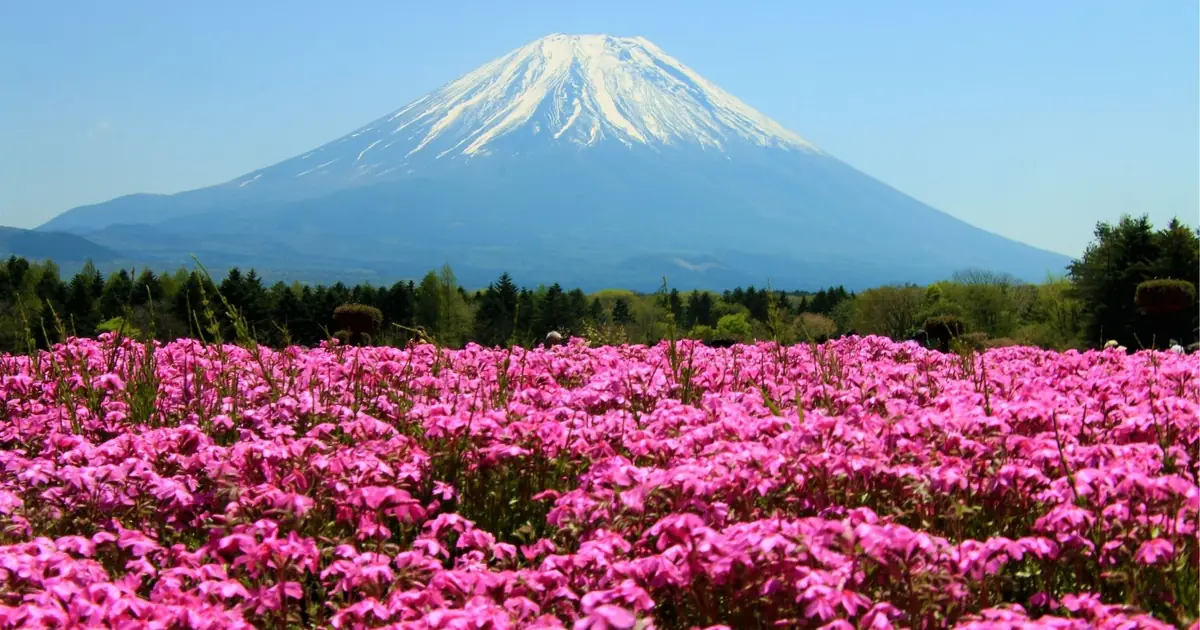
See Nagatoro and Chichibu above. The pink-and-purple carpet of moss phlox, with Mount Buko behind it, peaks from mid-April to early May.
The coast
Enoshima (about 1 hour 10 minutes): an island shrine and sea views
A small island joined to the Shonan coast by a bridge, with Enoshima Shrine (dedicated to the goddess Benzaiten), an observation tower, sea caves and an aquarium nearby. It pairs naturally with Kamakura on the Enoshima-Kamakura Freepass and the old-fashioned Enoden line. A good relaxed half day by the sea. The Hakone Ropeway, Owakudani and Enoshima coach tour ends its Fuji and Hakone day at Enoshima, at 4.68 stars from 114 reviews and $53 a person.
The Izu Peninsula (Atami, Ito, Shimoda): sea, onsen and coastline
Beyond Atami, the Izu Peninsula has the Jogasaki coast, Mount Omuro and the white-sand beaches of Shimoda. Some places, Jogasaki with Mount Omuro, work as a day trip; the south of the peninsula, around Shimoda, is better with a night because of the distance.
Cities, shopping and food
Yokohama (about 25 to 30 minutes): Japan’s second city
Only 25 to 30 minutes from central Tokyo on the JR Tokaido or Yokosuka lines from Tokyo or Shinagawa, or the Tokyu Toyoko Line from Shibuya. The highlights: Japan’s largest Chinatown, the futuristic Minato Mirai waterfront with its Ferris wheel and Landmark Tower, the Red Brick Warehouse, the Cup Noodles Museum and the peaceful Sankeien Garden, best at cherry-blossom time or in autumn. The Yokohama-Minatomirai Pass (about ¥530) is handy for hopping between the sights. Half a day covers the waterfront and Chinatown; a full day adds Sankeien.
Karuizawa (about 65 to 80 minutes): a highland resort to take slowly
As little as 65 minutes on the Hokuriku Shinkansen (about ¥6,000 one way, fully covered by the JR Pass and the JR Tokyo Wide Pass). A cool resort town with the huge Karuizawa Prince Shopping Plaza outlet mall, cycling, Shiraito Falls and autumn colour. You can do it in a day, but its relaxed pace and scattered natural sights repay a night.
Odawara (about 35 minutes): a castle and the gateway to Hakone
Most people pass through on the way to Hakone, but Odawara has a reconstructed hilltop castle and is a convenient, cheaper place to start the Hakone Free Pass if you have a JR Pass as far as Odawara.
Which trips work in a day?
- Comfortable in a day: Yokohama, Kawagoe, Mount Takao, Kamakura, Enoshima, Atami, Hakone, Mount Fuji and Kawaguchiko, Narita, Ashikaga Flower Park, Hitachi Seaside Park, Nagatoro and Chichibu, Sawara.
- Possible but rushed, or better with a night: Nikko (yes for the shrines, no for the scenery), Karuizawa (fine in a day, but it is a place to slow down), Mashiko (a long journey).
- Best as an overnight: Kusatsu Onsen (no station, three to four hours or more each way) and the south of Izu (Shimoda).
Rail passes: which one, when
- JR Tokyo Wide Pass: unlimited travel on JR East (and some partner lines) for three consecutive days, now ¥16,000 for adults and ¥8,000 for children aged 6 to 11 after a JR East price rise on 14 March 2026 (it was ¥15,000). It pays off only if you make several longer trips in those three days, such as Kawaguchiko, Nikko and Karuizawa. It covers Fuji (via Fujikyu), Nikko, Karuizawa, GALA Yuzawa and parts of Izu. For one short trip it is overkill. Check the current price when you buy.
- Hakone Free Pass: the default for the Hakone loop; it covers the Odakyu return trip and all transport around Hakone (about ¥7,100 for two days from Shinjuku, ¥6,000 from Odawara). The price rose in late 2025.
- Enoshima-Kamakura Freepass (about ¥1,640 from Shinjuku): worth it if you will ride the Enoden several times around Kamakura and Enoshima.
- Nikko World Heritage Area Pass (about ¥3,000): good for the town and the shrines. The wider Nikko All Area Pass roughly doubled in price to about ¥8,000 in 2025, so many visitors now combine the cheaper pass with local bus passes.
- Seibu 1-Day Pass (about ¥1,000, or about ¥1,500 with Nagatoro): for Chichibu and Nagatoro.
- Yokohama-Minatomirai Pass (about ¥530) and Keio’s Takao 1-Day ticket (about ¥1,690): small savings on single routes.
Crowds and timing
Kamakura, Hakone and the flower parks at their peak are the most crowded, so go on a weekday and leave early. Ashikaga in Golden Week and Hitachi at the height of the nemophila are extremely busy: arrive when they open. Kawagoe, Sawara, Mashiko and Mount Nokogiri stay comparatively calm. At Kamakura’s Slam Dunk crossing, respect the neighbours: the crowds have already pushed the city into unusual measures.
What changed in 2025 and 2026
- Overtourism in Kamakura: the toilets at Kamakura-Kōkō-Mae Station were closed in late April 2025 after repeated vandalism (things flushed that should not have been), and the city has turned to crowdfunding to pay for crowd-control staff at the Slam Dunk crossing, where up to 200 people gather at busy times.
- Pass prices: the Nikko All Area Pass roughly doubled to about ¥8,000 in 2025; the Hakone Free Pass rose after a fare revision in October 2025; and the JR Tokyo Wide Pass went up to ¥16,000 and ¥8,000 on 14 March 2026.
- Kusatsu and Route 292: the road over Kusatsu-Shirane reopened to through traffic in May 2026 after the volcanic alert level was lowered, though the crater rim is still restricted. This matters if you are driving, or combining Kusatsu with Shiga Kogen.
What we would do
One day, and you want the classic: Mount Fuji and Kawaguchiko, for the view (the direct Fuji Excursion from Shinjuku takes about 1 hour 54 minutes at ¥4,200; book ahead, because it sells out), or Hakone, for the onsen-and-scenery loop. Our Fuji day-trip guide, Hakone guide, Fuji and Hakone in one day and transport guide cover the planning.
Culture without a long journey: Kamakura (on a weekday, starting early) or Kawagoe (the easiest half day, with almost no planning).
Nature: Mount Takao for an easy hike (best in autumn), or Nagatoro and Chichibu for the river boats and the gorge.
Flowers: time it exactly. Ashikaga for wisteria (late April to early May), Hitachi Seaside Park for nemophila (mid to late April) and kochia (mid-October), Chichibu for shibazakura (mid-April to early May). Check the bloom within a week of travelling.
A slow day: Atami for the nearest sea-view onsen. Keep Kusatsu for an overnight instead of squeezing it into a day.
Choosing tickets:
- Only doing one day trip? Buy ordinary tickets or a single-route pass (the Hakone Free Pass or the Enoshima-Kamakura Freepass), and skip the JR Tokyo Wide Pass.
- Three longer trips in three days? The JR Tokyo Wide Pass probably pays off, but add up the return fares for your actual trips and compare them with the ¥16,000 price first.
- A flower trip? Let the bloom forecast set the date, not your calendar.
When to change the plan:
- If your destination is 90 minutes or more away and you cannot leave by about 8 a.m., think about staying the night.
- If a flower park is more than a few days outside its published peak, go somewhere that is good all year instead: Yokohama, Kamakura or Kawagoe.
- If it is a weekend in peak season, expect Kamakura, Hakone and Ashikaga to be very crowded, and consider somewhere quieter: Sawara, Mashiko or Chichibu.
The caveats that matter
Check every price and date before you travel. Fares, admission and pass prices change often; several Kanto passes were repriced in late 2025 and early 2026, including the JR Tokyo Wide Pass on 14 March 2026. Flower and autumn-colour dates move with the weather each year, so check the official park websites and the bloom forecasts within a week of your visit.
Journey times are approximate and depend on where in Tokyo you start, the type of train (limited express or local) and the changes.
Some figures come from travel media and operators and not from one official database. Where sources disagreed, as on the JR Tokyo Wide Pass price around the 2026 change, this page uses the current, post-change figure and flags it for checking. For the Fuji Excursion it uses Fujikyu Railway’s official ¥4,200 fare, not the ¥4,130 that some sites still quote.
This is a round-up. For full planning of a Mount Fuji, Hakone or combined Fuji and Hakone day, with detailed itineraries and transport, see our dedicated guides below.
Tour prices are the GetYourGuide starting prices for the listings named and vary with the operator, season, group size and inclusions. Ratings and review counts were checked on each listing on 18 September 2026.
Related reading
- Mount Fuji day trip from Tokyo — every way to do Fuji in a day, compared
- Hakone day trip from Tokyo — the loop, the pass and how long it really takes
- Mount Fuji and Hakone in one day — what the combined day costs you in time
- Tokyo to Mount Fuji: the transport guide — every bus, train and driving route, priced
- Lake Kawaguchiko: the complete visitor guide — what to do at the lakes, and where to stay if you make it a night
- Compare all six private Fuji tours — side by side, with live prices
Your Own Car, Your Own Day at Mount Fuji
Rated 4.9/5 by 675 travellers. Hotel pickup in Tokyo, an English-speaking driver-guide, and an itinerary you set yourself — with free cancellation up to 24 hours before.
Check Availability & Book