Best Time for a Mount Fuji Day Trip from Tokyo: Visibility, Seasons & 5th Station
The best time for a Mount Fuji day trip depends on what you want from it. December and January are the clearest months for a snow-capped mountain, at the cost of the shortest days and the least reliable 5th Station access. Cherry blossom at the lakes usually peaks around mid-April, November pairs autumn colour with clear mornings, and May, June and October are the safer months for sightseeing at the 5th Station. This guide compares them and checks conditions for your own date.
If your dates are already fixed, use the date checker below to see the cloud forecast around Mount Fuji, the likely Fuji Subaru Line status, and the seasonal scenery around Lake Kawaguchiko.
The short answer
Private Mount Fuji sightseeing day trips from Tokyo are available year-round, but how much of the mountain you see changes dramatically with the season. Cloud around the summit is the usual reason it is hidden, and that cloud often sits there when the sky below is clear. In Fuji City's record, kept from the southern side, 35 years produced 7,050 clear mornings on the plain below but only 4,684 on which the entire mountain was visible.
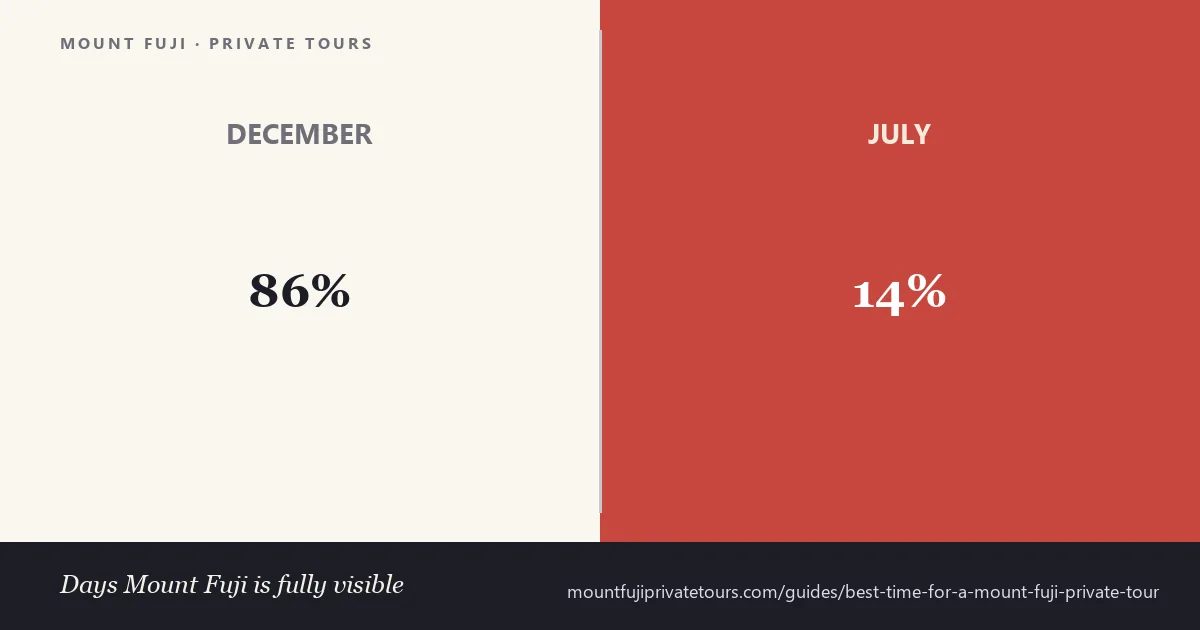
If seeing the mountain clearly is your main priority, December is the best month for clear views, with January close behind. In Fuji City's record the entire mountain was visible at 8am on 61.7% of December mornings and 60.0% of January mornings, against 41.1% in October and 9.9% in July. Summer is the least reliable season for views, even though it is the official climbing season. The summit is not capped all year: the snow is normally gone by August and returns in October, though in 2024 not until 7 November.
Winter's main drawback is 5th Station access. The Fuji Subaru Line has no closed season, but it reaches the 5th Station only when snow and road conditions allow, and the upper road can shut for long stretches in winter and early spring. A winter day trip may stop lower on the mountain instead.
For scenery, cherry blossom at the lakes usually peaks around mid-April, moving by more than a week from year to year. The shibazakura is a different flower, a carpet of pink moss phlox below the mountain, and its festival ran from 11 April to 24 May in 2026. November pairs autumn colour with the best view outside December and January: the entire mountain was visible on 53.9% of its mornings in Fuji City's record. It was also the busiest month in Fujikawaguchiko's 2024 count of visitors to the town, and January, for fewer people, sat near the bottom, though that count covers one town in one year rather than heads at a viewpoint.
Whatever month you visit, start early. Mount Fuji is more likely to be fully visible in the morning, before cloud builds around the summit: the same Fuji City observers recorded it at 8am on 36.6% of days and at 4pm on 22.5%. That is a useful guide to the seasonal pattern, but no equivalent record is published for the Kawaguchiko side, so check the cloud forecast before you leave Tokyo.
What you want, and when to come
- Best chance of clear views
- December and January
- Clear views with autumn colour
- November
- Cherry blossom around Kawaguchiko
- Around mid-April, varying by year
- The shibazakura carpet (moss phlox)
- Mid-April into May
- 5th Station sightseeing outside peak summer
- May, June and October, conditions permitting
- Official climbing season
- July to September
- Fewer people, still clear
- January
- Best time of day, in any month
- Early morning
- Most useful live checks
- Cloud cover · road status · traffic
Key figures
- Whole mountain visible at 8am: 61.7% of December mornings, 9.9% of July mornings, measured from Fuji City on the southern side
- Same record, by hour: 36.6% of days at 8am, 22.5% at 4pm
- 5th Station reachable by road, February 2026: 0 days of 28
- Daylight at the lakes: 9h 47m in mid-December, 14h 32m in mid-June
Check your date
Pick the day you plan to go. Within about two weeks the card reads the live forecast for Lake Kawaguchiko and averages the cloud over the morning viewing window, 6am to 10am. Beyond that it falls back to the long-run record and says so. It also gives that month's record, the likely state of the road to the 5th Station, what is in season under the mountain, and how busy the drive is that day.
Pick a date to see what it usually offers and what the forecast says. A summary of the year is below.
The shape of a Mount Fuji year
- Clearest mornings: December and January, then November and February
- Least clear: June, July and August, when the mountain is inside cloud on most mornings
- The entire mountain is visible far more often at 8am than later in the day, in every season
- Snow shut the top of the road to the 5th Station through February and March in each of the last three winters; January has ranged from 13 reachable days to none. The road is also closed to private cars during the summer climbing season
- Snow normally returns to the summit in early October and is gone by August
If the mountain is one stop in a longer Japan trip, the list below shows other tours and tickets around Fuji, Hakone and Tokyo, and it updates on its own.
How often you actually see Mount Fuji on a day trip
Fuji is big enough and isolated enough to build its own cloud, so a flawless sky in Tokyo tells you very little about what is waiting a hundred kilometres west. The city of Fuji has been measuring exactly that since 1991. Staff look at the mountain from the eighth floor of the city hall three times a day, at 8am, noon and 4pm, and record whether the whole mountain, part of it, or none of it is in view.
Two numbers out of that record do most of the work. Over 35 years the observers logged 7,050 clear mornings on the plain below — and the entire mountain was visible on only 4,684 of them. In August the gap is at its widest: 582 clear mornings produced 158 full views.
That is the practical meaning of a mountain that makes its own weather. A clear forecast is necessary and it is not sufficient, which is why a tour that can change its mind on the morning is worth more here than at most landmarks.
The same record sets out the whole year. Averaged across the 35 years, the entire mountain was in view at 8am on 36.7% of days, partly in view on another 22.3%, and hidden on 41.0%. In a normal year that is about 134 mornings with a full view; the count has run from 98 in 2018 to 162 in 2021, and 2025 came in at 136.
One scope note, because it matters and almost nobody states it: these observations are made from Fuji City, on the southern side of the mountain. Tours from Tokyo go to the northern side, around Lake Kawaguchiko, and no equivalent long-run count is published there. The shape of the year is the same on both sides — winter clear, summer clouded — but treat the percentages as the best available measure, not as a north-side figure.
Most visitors choose their dates for Tokyo or a wider Japan trip, not for a Mount Fuji day trip alone. Spring adds cherry blossom, autumn adds red and gold foliage, and winter gives the clearest views. Once your travel dates are fixed, the thing you still control is which morning you use for Fuji — so pick the one with the best cloud forecast.
Month by month
Visibility is the city of Fuji’s 8am observation, averaged across the 35 years. Temperature, rain and daylight are for Lake Kawaguchiko at 860 metres, where the tours actually stop — the summit is a different world, averaging −18.2 °C in January.
| Month | Whole mountain visible | Avg high | Rain | Daylight | What is happening |
|---|---|---|---|---|---|
| January | 60.0% | 5.5 °C | 60.9 mm | 10h 01m | Almost as clear as December; snow-capped, with sub-zero mornings |
| February | 52.6% | 6.6 °C | 55.4 mm | 10h 53m | Still clear, but the road has not reached the 5th Station in any of the last three Februaries |
| March | 40.7% | 10.5 °C | 107.6 mm | 11h 54m | Fewer full views; the road has not reached the 5th Station in any of the last three Marches |
| April | 36.3% | 16.1 °C | 106.1 mm | 13h 03m | Cherry blossom at the lakes and the pagoda; the road reopens |
| May | 30.2% | 20.6 °C | 123.2 mm | 14h 01m | Shibazakura in carpet; mild and long days, fewer full views |
| June | 12.4% | 23.0 °C | 157.1 mm | 14h 32m | The rainy season; the mountain is hidden most mornings |
| July | 9.9% | 27.2 °C | 178.4 mm | 14h 21m | The worst month for views, and the month the trails open |
| August | 14.6% | 28.1 °C | 176.8 mm | 13h 32m | Hot, and the summit is normally snow-free |
| September | 27.2% | 23.8 °C | 264.7 mm | 12h 27m | The wettest month and the peak for typhoons |
| October | 41.1% | 18.3 °C | 230.0 mm | 11h 21m | The snow cap returns, usually in the first days; kochia turns red |
| November | 53.9% | 13.8 °C | 76.0 mm | 10h 20m | The mountain in full view on over half of mornings, with peak autumn colour |
| December | 61.7% | 8.5 °C | 49.8 mm | 9h 47m | The best month on the record, and the shortest days |
Two things in that table surprise people.
September, not the rainy season, is the wettest month at Lake Kawaguchiko, at 264.7 mm against June’s 157.1 mm. The rainy season is the reliably grey period — the Japan Meteorological Agency puts it at around 7 June to 19 July on average for this region — but the heavy rain totals come later, with the typhoons. September is also the peak month for typhoons approaching this part of Japan, at 1.2 a year against August’s 0.8.
The clearest months are the coldest and shortest. December offers 61.7% of mornings with a full view and 9 hours 47 minutes of daylight; June offers 12.4% and 14 hours 32 minutes. A winter day gives you a better mountain and less time to enjoy it, which is the single strongest argument for an early pickup in those months.
Why the hour of your Mount Fuji day trip matters as much as the month
The month sets your chances. The hour decides how much of that chance you actually get, and because the city of Fuji records its three daily observations separately, the size of the effect is published rather than guessed at.
| Observation | Whole mountain visible | Whole or part visible |
|---|---|---|
| 8am | 36.6% | 58.9% |
| Noon | 23.3% | 53.4% |
| 4pm | 22.5% | 49.7% |
Across the whole record the mountain was fully out at 8am on 36.6% of days and at 4pm on 22.5% — about half as often again in the morning. Solar heating pushes moist air up the slopes through the day and cloud gathers around the summit, so the pattern holds in every season: winter mornings beat winter afternoons, and August mornings beat August afternoons.
This is the one lever every reader controls, whatever their dates. On a chartered car the departure time is yours to set, and the difference between a 6am and an 8am pickup from Tokyo is roughly the difference between arriving inside the best hour and arriving after it. If your guide suggests leaving before dawn in winter, that is why.
Treat a clear afternoon as a bonus rather than a plan. Our visibility guide works through the same record in more detail, including the webcams worth checking on the morning itself.
When a Mount Fuji day trip can reach the 5th Station
The Fuji Subaru Line is the toll road up to the Yoshida 5th Station at about 2,305 metres — the highest point a Fuji day from Tokyo reaches, and the only stop on such a day that feels like being on the mountain instead of looking at it. It is also the part of a Fuji day most often mis-sold, in both directions.
It has no closed season. The operator, the Yamanashi Prefectural Road Corporation, runs the road all year and publishes monthly gate hours, with no winter shutdown. How far up it goes changes day to day.
And it is usually impossible in late winter anyway. From the operator’s own daily log, the 5th Station was reachable on 13 days in January 2026, none at all in February, and none in March. Yamanashi’s own press release puts the last 5th-Station day of that winter on 18 January and the reopening of the full road on 18 April — 89 consecutive days. February and March 2025 were also blank, and so were January, February and March 2024. On those days the road still opens; it simply stops at a car park lower down, around 1,660 metres, in the trees. A February booking that promises the 5th Station is promising a view of the forest.
In midwinter the gate opens at 09:00. From December through February the road runs 09:00 to 16:00, with everyone off it by 17:00, so a sunrise trip to the 5th Station is not possible in those months at any price. Sunrise from the lakes is a different matter, and the better plan.
In the climbing season you cannot drive it at all. During the summer restriction private vehicles are barred and access is by shuttle from the Fujisan Parking car park. In 2026 that ran from 6pm on 3 July to 6pm on 10 September; the 2027 dates are not yet published, and Yamanashi announces them in late April. If the 5th Station matters to you in summer, ask the operator how they handle the shuttle before you book rather than on the morning.
Two smaller things catch people out. The toll is cash only — no cards and no ETC — which catches out visitors in hire cars. And the ¥4,000 fee that dominates the coverage is a climbers’ fee, collected at the trail gate at the 5th Station; a sightseer who drives or rides up and does not start walking up the mountain pays nothing beyond the toll or the bus fare. Our 5th Station guide covers the access rules in full, and the climbing season rules cover the fee and the gate.
So the honest version of the road’s calendar is: May, June and October are the months when you can both drive it and expect it to reach the top. October and late April usually work too, and early November often still does; the rest of the year gives you either a shuttle or a car park.
Blossom, shibazakura and autumn colour
The mountain is the constant. The seasons underneath it are not, and they are the reason one month looks different from another in photographs.
The snow cap normally returns in early October — the average date for the first cap is 2 October, though it came on 23 October in 2025 and as late as 7 November in 2024, the latest since records began in 1894. It is normally gone by August: the summit’s average maximum snow depth peaks at 206 cm in April and reads zero in August. So the honest answer to whether Fuji always has snow is no, and the climbing season is deliberately set in the bare window.
Cherry blossom at the lakes runs later than Tokyo’s because Kawaguchiko sits at 860 metres — usually around mid-April on the lake shore, and early to mid April at the Chureito Pagoda, where Fujiyoshida City’s own eight-year chart puts full bloom most often between about 10 and 16 April. The bloom moves by more than a week from year to year, so watch the season’s forecast instead of booking on a date from a guide. One current caveat: Fujiyoshida cancelled the 2026 blossom festival at Arakurayama Sengen Park, citing over 10,000 visitors a day at peak bloom, and ran a traffic-control period instead. Whether it returns is not published.
The shibazakura, the moss-phlox carpet, runs at Fuji Motosuko Resort from the second Saturday of April for about six weeks; in 2026 that was 11 April to 24 May, and the 2027 dates are not out. The venue is not on Lake Kawaguchiko at all — it is on Route 139 about 3 km inland from Lake Motosu, roughly 40 minutes by shuttle from Kawaguchiko Station, so it is a real detour to agree with your guide in advance. There is no official best-week for the flowers themselves; the only published signal is the operator’s own pricing, which charges its peak rate from 25 April to 10 May.
Autumn colour at the Maple Corridor on the north shore is published as peaking from late October to mid-November, though forecasters put it later, into the second half of November, and the festival’s own start date has moved later three years running — 26 October in 2024, 1 November in 2025, 7 November in 2026. Take the range rather than a date.
Kochia, the round bushes at Oishi Park that turn scarlet, are given as early to late October, with the prefecture and the park’s own neighbours disagreeing by a fortnight; mid-October is the period both agree on.
One thing to strike from older guides: the Kawaguchiko Herb Festival has been discontinued. The town ended it permanently after the 2025 edition, after more than thirty years, citing crowding. The lavender at Oishi Park and Yagizaki Park is still there, still free, and still flowers from late June into mid-July — there is simply no festival around it any more, whatever the listings say.
How busy it gets, and the drive
Two different things get called crowds here, and only one of them is measured at the mountain.
Yamanashi counts visitors to Fujikawaguchiko town. In the 2024 figures, the most recent published, November was the busiest month at 664,000, with September and January lowest at 321,000 and 322,000 — which is not the shape most people expect, and it puts the peak squarely on the month with the best combination of full views of the mountain and colour. December, the month with the clearest mornings, took 333,000: about half November’s total. September and January are close enough to count as tied, and of the two January is much the better bet for seeing the mountain, at 60.0% of mornings against September’s 27.2%. Treat that as one year’s pattern, not a rule: the series has breaks in 2020 and 2023, the town rose 46% on 2023 with no explanation given, and the 2025 edition is not out.
The wider measure is guest nights across Yamanashi, which is a proxy — it counts nights sold across a prefecture that also holds Kofu and the Yatsugatake highlands, and it misses every day-tripper, which is most of the Kawaguchiko crowd. It is useful for one thing: the peaks run on different clocks. Total nights peak in August with Japanese domestic holidays, while nights sold to foreign visitors peak in April and bottom out in September.
The drive is its own season. Two hours each way from Tokyo in normal traffic, and NEXCO Central Japan publishes forecasts for the holiday peaks. On the worst days of 2026 the Kobotoke Tunnel heading back into Tokyo carried a 30 km queue taking about 120 minutes against about 25 minutes normally; outbound, Sagamiko was worse still. Those are peak-day figures for named dates, not averages, and NEXCO publishes nothing at all for ordinary weekends.
What that means in practice: on Golden Week, Obon and the New Year period, budget the extra time or start before dawn. In 2027 Golden Week is a clean five-day run from Saturday 1 May to Wednesday 5 May, and there is no Silver Week at all. Lost hours cost you stops, because a Fuji day only has four or five of them.
Which day trip suits your month
The format matters more in the difficult months than the easy ones. In December a coach and a car both show you the same clear mountain. In July, the ability to reorder the day is the whole difference.
A route agreed on the morning
The most-reviewed Fuji-only private day on the market, with the itinerary set with your driver-guide on the day, not weeks ahead — which is what you want in a marginal month.
Check tour availabilityA custom itinerary, with Hakone as a fallback
Ten to eleven hours on the north side with an optional Hakone extension — useful in summer, when the onsen, the ropeway and Lake Ashi work whatever the summit is doing.
Check tour availabilityDoor to door, with the guide at each stop
Hotel pickup and drop-off with the guide walking the stops with you instead of waiting at the car — the easier shape for a winter day, when the light is short and the stops are cold.
Check tour availability
Whichever month you choose, a booking you can cancel lets you act on the forecast instead of hoping. That is worth more in June than in December. Our private-versus-group comparison works through where the money lands, and the cost guide covers what the inclusions add up to.
How we know
Visibility. 富士山観測の記録, the City of Fuji, Shizuoka — fixed-point observations from the eighth floor of the city hall at 08:00, 12:00 and 16:00, every day since 1991, classified as whole mountain visible, partly visible or not visible. The figures here are the 08:00 series across 1991–2025, from the city’s 35-year compendium. The city publishes it only as a PDF.
Climate. Japan Meteorological Agency 1991–2020 normals for Kawaguchiko, station 47640, at 859.6 m, and for the Fujisan summit station 47639 at 3,775.1 m. Rainy-season dates are the JMA’s confirmed values for the Kanto-Kōshin region; typhoon approach figures are the JMA’s 1991–2020 normals.
Daylight is computed for 35.51°N with the standard horizon, so it matches any public sunrise table to within a minute or two. Japan keeps no summer time, so no date here sits near a clock change.
The road. The Yamanashi Prefectural Road Corporation’s published gate hours and tolls, and its own daily operating log, which archives back to 2017. The 89-day figure is counted from that log; the start and end dates are from Yamanashi Prefecture’s press release of 15 April 2026.
Visitors. Yamanashi Prefecture’s tourism survey for 2024 (Fujikawaguchiko town, monthly) and the Japan Tourism Agency’s accommodation statistics for 2025 (Yamanashi, monthly). Traffic is NEXCO Central Japan’s published congestion forecasts. Ratings and review counts were re-checked against the live GetYourGuide listings on 21 September 2026; prices come from our own offers data and move.
Where this record stops
- The visibility record is measured from Fuji City, on the southern side. Tours from Tokyo go to the north, and no equivalent long-run count is published there.
- The city notes that its observations are made by eye, so the three categories are not strict. The headline figures are the 8am reading, the best of the three.
- Climate normals are thirty-year averages for one station at 860 m. They are not a forecast, and the summit is a different climate entirely.
- The town visitor series is one year. It has breaks in 2020 and 2023, and the town publishes a different total for the same year.
- Guest nights are a proxy for regional demand, not a count of people at a viewpoint, and they exclude day-trippers.
- NEXCO publishes peak against normal for holiday periods, never an average, and nothing for ordinary weekends.
- We have no monthly price data for private Fuji tours, so this page makes no claim about which month is cheapest.
- Every 2027 date for the road, the climbing season and the traffic forecasts was unpublished when this page was updated. They are announced in late March to late April.
Frequently Asked Questions
What is the best month to see Mount Fuji clearly?
December, narrowly, with January just behind it. In Fuji City's 35-year record the entire mountain was visible at 8am on 61.7% of December mornings and 60.0% of January mornings. The difference between them is small enough to treat them as a pair. November is the strongest month if you want the the mountain in full view and the autumn colour together, at 53.9%.
What is the worst month?
July, at 9.9% of mornings with the whole mountain in view, with June close behind at 12.4%. That is the awkward part of a Fuji trip: the season you can climb the mountain is the season you can barely see it from below. If your dates fall there, start at first light, stay on the Fuji Five Lakes side and treat a clear summit as a bonus.
What time of day is best?
Early morning. The same observers recorded the whole mountain at 8am on 36.6% of days, at noon on 23.3% and at 4pm on 22.5%, because cloud builds around the summit as the day warms. The pattern holds in every season, so an early pickup from Tokyo is worth more than most people expect.
Can you drive to the 5th Station in winter?
Usually not to the top. The Fuji Subaru Line has no closed season, but snow and ice routinely stop it short: in 2026 the 5th Station was reachable on 13 days in January and on no day at all in February or March. On those days the road still opens to a car park lower down. From December to February the gate also opens only at 09:00, so a winter sunrise at the 5th Station is not possible.
Does Mount Fuji always have snow on top?
No. The summit's average maximum snow depth peaks at 206 cm in April and reads zero in August. The first snow cap of the season is declared on average around 2 October, though it came on 23 October in 2025 and on 7 November in 2024, the latest since records began in 1894. The climbing season is set in the snow-free window.
When is the cherry blossom at Mount Fuji?
Usually early to mid April, later than Tokyo because Lake Kawaguchiko sits at 860 metres. Fujiyoshida City's own eight-year record puts full bloom at the Chureito Pagoda most often between about 10 and 16 April, but it shifts by more than a week from year to year, so watch the season's forecast. Note that the city cancelled the 2026 blossom festival at Arakurayama Sengen Park over crowding and has not published whether it returns.
Is there a month to avoid because of crowds?
In Fujikawaguchiko's own 2024 visitor count the busiest month was November and the quietest September — not the shape most people assume, and it is one year of data, not a rule. The bigger practical problem is the road on Golden Week, Obon and at New Year, when NEXCO's forecasts put the worst queues into the Kobotoke Tunnel at about two hours against a normal twenty-five minutes.
Is rain the main risk?
Cloud is, and the two are not the same. Lake Kawaguchiko's wettest month is September, at 264.7 mm, but September is a better month for views than June, which takes 157.1 mm. What hides the mountain is the cloud it generates around its own summit, which is why a clear regional forecast is not enough on its own.
Ready to pick a date? The featured private tour sets its route with you on the morning, which is the part that matters most in a marginal month.
Your Own Car, Your Own Day at Mount Fuji
Rated 4.9/5 by 675 travellers. Hotel pickup in Tokyo, an English-speaking driver-guide, and an itinerary you set yourself — with free cancellation up to 24 hours before.
Check Availability & Book