Chureito Pagoda: The Complete Visitor Guide
Free, gateless and 398 steps up. How to reach Chureito Pagoda, when to go, and what the 2026 festival cancellation and April access restrictions actually change.
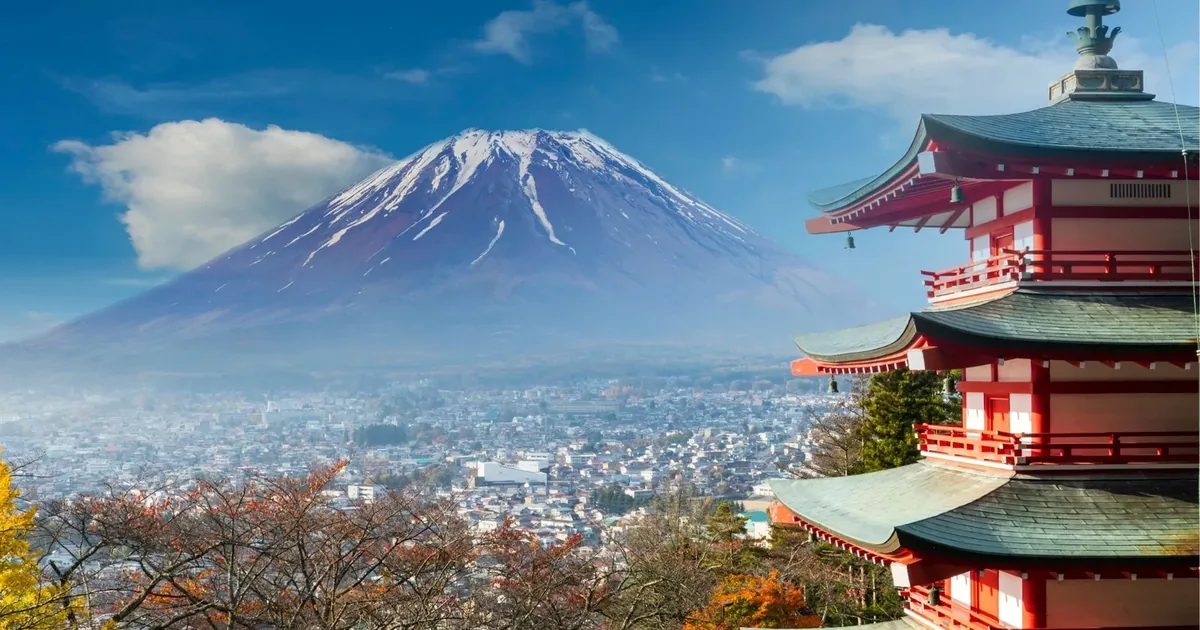
Chureito Pagoda is free, has no gate to close, and sits 398 stone steps above a shrine in Fujiyoshida — which is why the most photographed view in Japan is also one of the easiest to get wrong. Turn up at eleven in blossom season and you will queue forty minutes for a five-metre platform. Turn up at seven in February and you may have it to yourself, with the clearest Fuji of the year behind it. And 2026 changes the calculation again: the cherry blossom festival has been cancelled outright, and for two and a half weeks in April you cannot drive to the park at all.
Check Availability
What Chureito Pagoda actually is
Chureito Pagoda (忠霊塔) is a five-storied peace memorial built in 1963, standing above Arakura Fuji Sengen Shrine inside Arakurayama Sengen Park in Fujiyoshida City, Yamanashi Prefecture. It commemorates local residents who died in wars from the mid-19th century through the Second World War. Its elevated position is what makes the photograph: the pagoda’s tiered red eaves in the foreground, Fujiyoshida City spread out below, and Mount Fuji rising behind all of it.
The site is far older than the pagoda suggests. The shrine at the base of the hill dates to 705 CE, dedicated to Konohanasakuya-hime, the goddess associated with Mount Fuji. When Fuji erupted in 807, a ritual was held here to calm the mountain’s spirit, and Emperor Heizei granted the shrine the title Sangoku Daiichi — “the top shrine of the region”. The park itself opened to the public in 1959, with the pagoda added four years later.
Admission is free and the park has no gates. There is no ticket office and no enforced opening hours, which is precisely what makes a pre-dawn arrival possible if you are staying nearby — the single most useful fact on this page.
The 2026 change: no festival, and no driving in April
Fujiyoshida cancelled the Arakurayama Sengen Park Sakura Matsuri entirely for 2026. The announcement came on 3 February — about eight weeks ahead of the festival’s usual April run — citing overtourism, littering, trespassing onto private property, and the strain on residents’ daily lives. Mayor Shigeru Horiuchi stated that “protecting residents’ living environments and dignity must come first.” It is the first cancellation since the festival began in 2016.
In practice that means no vendor marketplace, no nightly pagoda illumination, and no extended festival-period parking. The pagoda and the park themselves remain fully open and free. Only the festival infrastructure and the easy driving access are affected.
Because a significant number of visitors is still expected anyway, the city has imposed a formal measure-enforcement period from 1 to 17 April 2026, with related bus restrictions running 1 to 19 April:
| Measure | Detail |
|---|---|
| Vehicles | Prohibited from approaching Arakurayama Sengen Park directly. Visitors are asked to use public transport. |
| Park parking | The No. 1 lot, next to the park, is unavailable for the whole period. |
| Charter and tour buses | Barred from approaching Shimoyoshida Station. A temporary tour-bus lot is designated elsewhere and passengers must walk in; drop-off and pick-up in the immediate area is prohibited. |
| Accessible parking | Available at Nyoraiji Temple, about a 5-minute walk from the park — requires proof of disability, open 09:00–15:00, ¥500. |
| On the ground | Security personnel, road closures and temporary toilet facilities deployed to manage congestion even without the festival. |
Outside that April window, standard municipal parking is available at either ¥1,000 or ¥1,500 for up to six hours depending on the specific car park, with motorcycle parking at one lot running ¥750 for up to six hours.
The practical read: if you are visiting between roughly 1 and 19 April 2026, expect no festival atmosphere, restricted vehicle and tour-bus access, and a genuine push toward the train. Every other week of the year, the old rules apply.
Getting there
By train — the recommended route. The nearest station is Shimoyoshida on the Fujikyu Railway, about a 10-minute walk from the shrine entrance.
- Fastest: the direct Fuji Excursion limited express from Shinjuku, roughly 105 minutes (the city’s own seasonal guidance sometimes rounds this to about two hours), with four trains per day. Reserve ahead.
- Cheapest: a regular limited express from Shinjuku to Otsuki (~60 minutes), then transfer to the Fujikyuko Line for Shimoyoshida (~50 minutes). A Japan Rail Pass covers the Shinjuku–Otsuki leg; the Fujikyu line onward is a separate ticket.
- From Osaka or Nagoya: Tokaido Shinkansen to Mishima, then the Mishima–Kawaguchiko highway bus (~80 minutes) to Fuji-Q Highland Station, then the Fujikyuko Line 10 minutes to Shimoyoshida.
By highway bus. From Busta Shinjuku on the Shinjuku–Fujigoko Line via the Chuo Expressway, about 115 minutes to Fujisan Station; from Tokyo Station on the Tokyo–Fujigoko Line, about 120 minutes, also to Fujisan Station — one stop from Shimoyoshida. Our transport guide prices every one of these routes properly.
On foot from the station. Ten minutes from Shimoyoshida to the shrine entrance, through the torii gate, then the climb begins.
By private car. This is the format that removes the connection problem entirely — no Otsuki transfer, no four-a-day timetable, and the freedom to leave when the light is right rather than when the train is. The Mount Fuji Private Tour With English Guide lists Chureito Pagoda as its first named stop and is the most-reviewed Fuji-only private day on the market at 4.9 stars from 880 reviews, $319 for a small group, with a full breakdown of the day here. If you would rather have a guide who walks the site with you rather than waits at the car, the Private Mount Fuji Tour With Pickup and Drop-Off allots 45 to 60 minutes at the viewpoint and rates 4.9 stars from 325 reviews at $341, and has its own page here. During the 1–19 April window, though, take the train: the vehicle restrictions apply to private cars and charter buses alike.
The climb: 398 steps and what they ask of you
- 398 stone steps, officially the Sakuya-hime stairs after the shrine’s goddess, lead from the shrine up to the pagoda. The observation area sits roughly 100 metres above the parking lot, and there are a further ~30 stone steps beyond the pagoda to reach the best viewing angle — the one in every photograph.
- A gentler sloped path runs alongside the main stairway, for visitors with leg problems, low physical confidence, or anyone who would simply rather not take stairs. It is still an uphill walk, not a flat route.
- Footwear matters more than people expect. Sneakers or sports shoes; heeled shoes, leather soles and sandals are all discouraged on rough, uneven ground with steep sections.
- The observation deck is small — a platform roughly five metres wide, holding about 15 people comfortably. That, not the stairs, is the real bottleneck.
- A safety-driven deck upgrade was installed in February 2022 at the popular shooting spot behind the pagoda, a response to crowding concerns that predate the current overtourism measures by years.
If stairs are a genuine problem, weigh this stop honestly: there is no way to reach the observation deck without climbing. Our walkthrough of a private Fuji day covers how guides handle the stop for travellers who would rather skip it.
Crowds and timing
This matters more than the climb, and more than anything else on this page.
- Peak periods are the first week or two of April, during cherry blossom bloom, and the autumn foliage weeks. In peak blossom week a 40-minute queue for the small observation platform is normal.
- Early morning is doubly valuable here. It gives you the best chance of a full view, before the midday cloud that typically builds around Fuji, and meaningfully smaller crowds, since most visitors arrive mid-morning onward.
- February is a genuine off-peak alternative. Some visitor guides recommend it specifically for travellers who want the classic shot without the crowds, and winter mornings often carry the clearest Fuji visibility of the year — you trade the blossom for the mountain.
- Reviewer sentiment is consistent even accounting for the crowds: visitors describe the scenery as “peaceful and serene” and the climb as “rewarding”, with the view frequently called incredible. Multiple accounts describe the queue itself as manageable and scenic.
One honest limitation worth stating plainly. No day tour from Tokyo gets you here at sunrise. A private car picking up at 07:00–08:00 in the 23 wards arrives around mid-morning; a coach later still. Sunrise at Chureito realistically requires staying in Fujiyoshida or Kawaguchiko the night before. If you are already lakeside, the Kawaguchiko private tour with a local guide starts at the mountain rather than in Tokyo — six hours with a licensed local guide, 5.0 stars from 54 reviews at $474, broken down here. From Tokyo, aim for “before nine” instead and accept that the truly empty platform belongs to people who slept nearby.
Season by season
Cherry blossom. Around 650 Somei Yoshino cherry trees were planted in the park, typically reaching full bloom in early-to-mid April, though the exact dates shift year to year — check the annual forecast before booking travel. This is the famous version of the shot: pink blossom, red pagoda, snow-capped Fuji. It is also the fortnight the 2026 access measures target. The Mt Fuji, Chureito Pagoda, Lake Kawaguchi and Oshino Hakkai tour is the highest-volume way to reach it without a car, at 4.8 stars across 5,794 reviews for $49.
Autumn foliage. The other headline season, generally running through November, giving a red-and-gold foreground instead of pink. The Mt. Fuji Heritage Tour through the traditional villages, lakes and shrines pairs Arakura Sengen Park with the seasonal maple tunnel at 4.5 stars from 555 reviews, $53 — the lowest-rated coach product named here, and worth weighing against the fact that it is the only one that includes the tunnel.
Winter. Often the clearest Fuji visibility of the year and the quietest crowds — the strong choice if a clean shot of the mountain matters more to you than seasonal foreground colour. Our month-by-month visibility guide sets out how much better the winter odds actually are.
Summer. Green foliage, warmer weather, and the least crowded of the non-winter seasons — but Fuji visibility is statistically weakest in summer haze, so you are trading the mountain for the comfort.
Pairing Chureito with the rest of a Fuji day
Chureito is a short stop, not a day. Forty-five minutes to an hour covers the climb, the photograph and a walk back down. What you put around it decides the day.
- Chureito plus Lake Kawaguchiko is the balanced pairing — lakeside walking, cycling or a calmer waterside Fuji view after the climb. The Mt Fuji, Oishi Park and Lake Kawaguchi tour covers six photo spots around the lake at 4.9 stars from 349 reviews, $49.
- Chureito plus Oishi Park works better if seasonal flowers and wide-angle lake photography are the priority.
- Chureito plus the 5th Station gets you altitude as well as the icon — the Luxury Land Cruiser day tour runs twelve hours taking in both plus Oshino Hakkai, 4.8 stars from 264 reviews at $355, with its own page here.
- Chureito plus Hakone is the most ambitious pairing, crossing to the volcanic side for Owakudani and Lake Ashi. The Hakone and Mt Fuji tour taking in Arakurayama and Oshino Hakkai does exactly that at 4.89 stars, though from only 50 reviews; the Mt. Fuji and Hakone tour covering Arakurayama, Oshino Hakkai and Owakudani runs the same north-and-south shape at 4.8 stars from 628 reviews for $49, and is the better-proven of the two. Read our standalone Hakone day-trip guide before committing — Hakone rewards a day of its own.
- Chureito plus the Lawson store and the Top 5 circuit suits photographers collecting the region’s set pieces; the Mt Fuji Top 5 Spots day tour strings Arakurayama, Oshino Hakkai, Oishi Park and the famous convenience-store shot together at 4.6 stars from 2,782 reviews, $55.
What does not work is trying to add every Fuji viewpoint in one day without a car — it backfires reliably. Our guide to the best places to see Mount Fuji ranks the alternatives by what each one actually gives you, and the day-trip planning guide sets out what genuinely fits between a morning departure and an evening return.
What we’d actually do
Go in February, on a weekday, and be there by eight. You lose the blossom and gain the mountain — winter carries the year’s clearest visibility, the platform is not queued, and none of the April access measures apply. This is the visit most people wish they had made.
If it has to be blossom season, target early-to-mid April, check the live bloom forecast within a fortnight of travel, and take the train. In 2026 the vehicle restrictions make public transport the reliable choice rather than merely the virtuous one, and the festival atmosphere you would have been paying the crowds for is not happening anyway.
Wear proper shoes, budget an hour for the stop itself, and pair it with exactly one other place. Chureito plus Kawaguchiko is a good day. Chureito plus four other viewpoints is a bus timetable with a view.
The caveats that matter
The 2026 Sakura Matsuri cancellation is a new policy shift, driven by overtourism, and it may or may not repeat. Verify the current-year festival status and access rules directly with Fujiyoshida city tourism before finalising travel plans, especially for the April window.
Parking fees, bus restriction dates and the measure-enforcement period are subject to annual revision. The 1–17 and 1–19 April 2026 dates cited here are specific to this year and should not be assumed to carry forward.
Cherry blossom dates vary annually with the weather. Treat “early-to-mid April” as a general guide and check the seasonal forecast shortly before you travel.
Fuji visibility is never guaranteed regardless of season or hour. This page describes when the odds are best, not a certainty.
Broader day-trip planning and ticketing detail lives elsewhere and is deliberately light here — see the day-trip planning guide and the transport guide.
Tour prices are the live GetYourGuide starting prices for the specific listings named, and vary by operator, season, group size and inclusions. Ratings and review counts were re-sourced from each listing on 12 September 2026.
Related reading
- The best places to see Mount Fuji — every viewpoint, ranked by what you want from it
- Hakone day trip from Tokyo — the other side of the mountain, as a day of its own
- Fuji Five Lakes: which lake should you actually visit? — where to base yourself for an early start
- The best time for a Mount Fuji private tour, month by month — the seasonal visibility odds in full
- Tokyo to Mount Fuji: every way to get there — fares, passes and routes
- Compare all six private Fuji tours — side by side, with live prices
Your Own Car, Your Own Day at Mount Fuji
Rated 4.9/5 by 675 travellers. Hotel pickup in Tokyo, an English-speaking driver-guide, and an itinerary you set yourself — with free cancellation up to 24 hours before.
Check Availability & Book