Climbing Mount Fuji: What It's Like
Mount Fuji is a long, high hike, not a technical climb. What the ascent, the altitude, the summit sunrise and the descent are like, what goes wrong, and who should go.
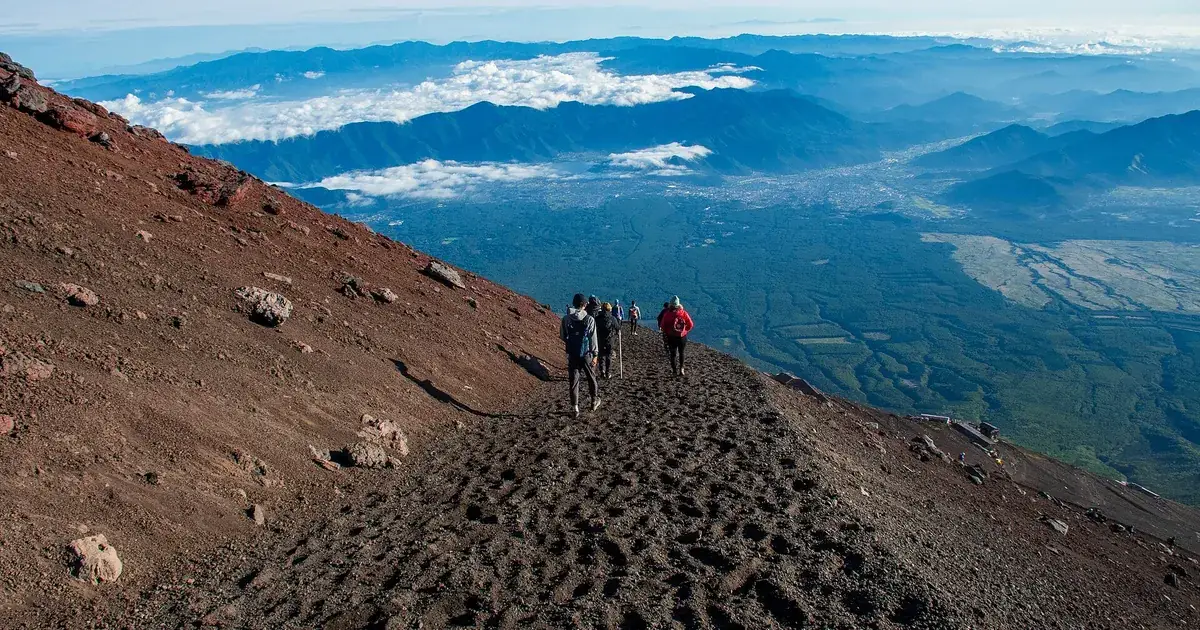
Climbing Mount Fuji is a hike. There are no ropes, no scrambling that needs a technique, and most of the people who reach the 3,776-metre summit each season have never climbed a mountain before. What makes it hard is the length of the ascent, the thin air near the top and the cold, often on a night with little sleep. The people who turn back are usually beaten by poor preparation more than by the mountain: too few layers, too fast a start, and a headache they chose to ignore. And the part most of them remember with the least affection is the descent, hours of switchbacks and loose volcanic grit that punish the knees long after the sunrise photographs are taken.
Check Availability
A hike, not a climb, and still hard
Ask people who have done it how hard Fuji is and you will hear two answers. Experienced hikers tend to rate it as one of the easier famous summits. One writer who had already hiked to Everest Base Camp and Machu Picchu concluded that “out of all the ‘major’ ones, Fujisan was definitely the easiest,” and that “if you are healthy, fit and not extremely elderly, Mount Fuji is not hard to climb at all — it’s really more of a hike.” Other guides push back on that. They warn that Fuji’s “elegant, symmetrical shape may give the impression of an easy hike,” and tell first-timers to “plan for a grueling, multi-day trek.”
Both are right. Fuji is technically simple and physically demanding. It asks for endurance and patience, not skill. The people who struggle are not defeated by the terrain; they underestimated a long ascent at altitude, in cold and wind, often through the night.
Altitude and weather carry the danger, not the terrain. One 2026 guide puts it bluntly: “Altitude — not difficulty — is the real risk. The summit sits at 3,776m and the air thins fast.” Another: “Fuji is not technically difficult, you don’t need climbing equipment. What gets people into trouble is lack of preparation, inadequate clothing and ignoring altitude sickness.”
Can a beginner do it? Yes, with honest preparation. The Yoshida Trail in particular is set up for first-timers, with the most mountain huts and first-aid stations of any route. What you need is “honest physical preparation over several weeks, not technical skill.”
The physical reality
Mount Fuji stands 3,776 metres high. It is Japan’s highest peak and an active stratovolcano. Climbers start at one of four 5th Stations, partway up the mountain (our Fuji Subaru Line 5th Station guide covers the most popular of them in depth). How much climbing you do depends on your route:
- Yoshida Trail (from about 2,300 m): the most popular route, used by more than half of all climbers. It has separate paths for going up and coming down, and more first-aid stations and mountain huts than any other trail. Because of the congestion, it is the only trail with a daily cap, of 4,000 climbers.
- Gotemba Trail (from 1,440 m): the longest route, with the most climbing of any, about 2,300 vertical metres from its 5th Station to the summit. Very few climbers use it, and guides recommend it only to people with mountain experience.
Our comparison of all four Mount Fuji trails sets the Fujinomiya and Subashiri routes alongside these two.
The terrain changes in a predictable order. Gentler lower slopes give way to steeper, rockier switchbacks, then to loose volcanic scree and cinder near the top. The last push to the crater rim is the steepest section, and the one with the least oxygen.
Timing: from the Yoshida 5th Station, the ascent typically takes 5 to 7 hours and the descent 3 to 5, though both vary widely with fitness, crowds and rest stops. One climber describes reaching their hut, Goraikō-kan at around 3,400 metres and the hut closest to the summit on that trail, after six hours of climbing.
Where it gets hard: the 7th and 8th Stations
The mistake cited most often is pace. As one guiding company explains: “As the elevation rises, the air becomes thinner making it more difficult to walk. A common mistake is starting out too fast, which can lead to headaches or altitude sickness by the time you reach the 7th or 8th station.”
This is the heart of the Fuji experience. The lower sections feel manageable, and many climbers say they felt strong, even bored, early on. The mountain turns hard between the 7th and 8th Stations, where thinner air, accumulated tiredness and steeper, rockier ground arrive together, and on a sunrise climb they arrive in the cold and the dark.
Altitude sickness in practice
Altitude sickness is the health problem sources flag most often on Fuji, and they describe it the same way: headaches, dizziness, nausea and fatigue, caused by the lower oxygen at height.
The prevention advice is consistent too:
- Acclimatise before you start. Spend time at the 5th Station first, typically one to two hours.
- Walk slowly and steadily, above all at the beginning. Starting too fast is the classic error.
- Drink water constantly.
- Rest at your hut to acclimatise if you are climbing overnight.
- Turn around if you become dizzy or nauseous, or develop a pounding headache.
For beginners, guides argue that a professional guide adds real safety here: “A guide can help manage your pace, preventing altitude sickness and hypothermia, and ensure a safe climb.”
Goraiko: the summit sunrise
Goraiko (御来光), the first sunrise seen from Fuji’s summit, is the emotional centre of the climb for most people, and the reason most ascents are planned overnight. The word comes from the Buddhist term raikō, and because of its height the summit sees the sun earlier than the plains below.
The timing in practice: climbers usually sleep at a hut on the 7th or 8th Station, then set off for the summit in the small hours. One detailed first-person account describes leaving the 8th Station at about 2:40 am for a 5:10 am sunrise, noting that in early July the sun rises earlier still, at around 4:30 am. They allowed extra time because crowds would slow the two-hour walk from hut to summit.
What it is like: crowded, cold and, by most accounts, worth it anyway. The same climber went on a Monday while Japan’s borders were still closed to foreign tourists and found that “the trail was packed with people,” yet describes the scene that made up for it: “the view of the zigzag path leading to the top, illuminated by the climbers’ headlamps, was truly unique.”
When the conditions cooperate, the reward is spectacular. From 3,776 metres the sun comes up over a sea of cloud and throws the shadow of the mountain’s cone west across the cloudscape. Conditions vary, though. Another climber met haze instead of the classic cloud sea, with “the first, intense rays of morning sun… not diffused by clouds but pierced directly through the haze, painting the world in powerful strokes of orange and gold,” and wrote that “with the warmth of the sun finally touching our faces, all the aches, the cold, and the exhaustive climb faded.”
If you would prefer to avoid the crush: the summit is badly congested at dawn, so some guides suggest watching the sunrise from your mountain hut and continuing to the top afterwards. You see the same sunrise without the crowd.
What is on the summit
The summit is not a single point but a whole crater, roughly 780 metres across, with a circumference of about 3 km.
What you will find up there:
- Ohachi-meguri (御鉢巡り), the trail around the crater rim. According to the official Mt. Fuji climbing site it is about 3.8 km long and takes around 90 minutes; other sources give 60 to 90 minutes. It follows an old pilgrimage route once walked by the Fujiko, the Edo-period religious groups who worshipped Mount Fuji, and there is no fee. It is straightforward on a clear day, but can be dangerous in wind, snow or thick fog, and it closes in bad conditions. One climber who had summited twice warned that the wind can be very strong and advised walking the rim only in good weather.
- Kengamine Peak (剣ヶ峰), the true high point at 3,776 metres, on the western edge of the crater rim and marked by the former Mt. Fuji Weather Station. It is about 40 minutes from the top of the Yoshida Trail, so if you want to see the sunrise from Japan’s highest point, budget an extra hour. It sits on the far side of the crater from where most people watch the sunrise, which is why it is easy to miss, and the queues for the photograph at the summit marker can be long enough that some climbers give up on it.
- Shrines: Kusushi-jinja near the top of the Yoshida Trail, and the Sengentaisha Okumiya near the top of the Fujinomiya Trail, where a Shinto priest is stationed through the climbing season. The shrine area is open around the clock, hut services run roughly 7:00 to 17:00 in season, and worship is free.
- The summit post office (富士山頂上郵便局), open in the climbing season from roughly 8:00 to 16:00, weather permitting. It offers a special summit postmark as proof that you mailed something from 3,776 metres. Bring cash, because card payments are unreliable at altitude, and go after the sunrise crowds have thinned, when the queue is shorter.
- Everything else: two springs, Kinmeisui and Ginmeisui; lava formations called Toraiwa and Ikazuchigaiwa, said to resemble a tiger and lightning; Konoshiro Pond near the top of the Fujinomiya Trail, which sometimes dries up in summer; summit stamps for hiking notebooks, at about ¥200; hot food including ramen; and, yes, vending machines.
The descent: the part nobody warns you about
First-person accounts agree on one point: coming down is harder on the body than going up. One climber puts it plainly: “We proceed down the mountain in silence. Progress is quick but descending is very hard on the legs. I keep feeling as if my knees will give way under me.”
On the Yoshida Trail, the descent follows its own path, separate from the ascent, down long, monotonous zigzags. The Gotemba route has the famous sunabashiri (砂走り), or sand run, a slope of volcanic ash where climbers can more or less run down, in about 2.5 hours on the scree-slide trail. It is the one descent on the mountain people describe as fun, but it sits on the least-used and most demanding route overall.
Trekking poles are widely recommended, above all to protect your knees on the way down.
What can go wrong
- The weather changes fast. At 3,776 metres, “the weather can change in minutes.”
- It is cold, even in August. Summit temperatures can fall to 0°C in midsummer, so layers are essential.
- Hypothermia is a real risk for underdressed climbers, especially on overnight ascents, when you stand still in the cold waiting for the sunrise.
- Rescues and deaths happen every season. One current guide says it plainly: “Every year there are rescues and, occasionally, deaths.”
- Climbing outside the official season is dangerous. Outside the season the mountain huts close completely: no shelter, no emergency help, no water or food, and you are entirely on your own in alpine conditions. The trails are not maintained, snow and ice cover the paths, signs are buried, and finding the route is hard even for experienced mountaineers. From October to June the mountain sees extreme winds, with gusts above 100 km/h, temperatures below −20°C, heavy snow and whiteouts.
How to prepare
The consistent advice is to train for elevation gain, over several weeks, and not to worry about technical skills you will not need. The honest baseline is being able to keep walking uphill with a pack for many hours in a row. As one guide sums it up: “Climbing Mount Fuji rewards preparation and punishes overconfidence.”
The cultural and spiritual side
Fuji is a sacred mountain with centuries of pilgrimage behind it, and the climb carries some of that with it. The Ohachi-meguri crater walk follows an old route walked by the Fujiko (富士講), the Edo-period religious associations devoted to Mount Fuji. Shinto priests are stationed at the summit shrine during the climbing season, and climbers traditionally pray for a safe ascent at the torii gates at the trailheads.
A few habits connect modern climbers to that tradition: buying a kongōzue, a wooden walking stick, and having it branded at the stations on the way up; collecting summit stamps; and the goraiko sunrise itself, a word with Buddhist roots.
Many climbers describe the summit sunrise in spiritual terms: “Witnessing the sunrise from the summit on a clear morning can be a truly spiritual experience.”
Should you do it?
Go if you are in reasonable health and fitness, you are willing to train for several weeks, you can commit to going slowly, and you accept that the climb comes with crowds, cold and discomfort alongside the beauty.
Consider a guided climb if you have mobility difficulties or an underlying health condition, you are an inexperienced hiker who would benefit from someone setting the pace, or you want the extra safety margin. A guide is not strictly necessary in the official season, when the trails are well marked and maintained, but guided climbs offer convenience, safety and cultural insight. Our guide to guided Mount Fuji climbs compares the operators and what they cost.
Think again if you are in poor physical condition, you are not willing to prepare, or you are considering a climb outside the season without serious alpine experience.
What climbers most often wish they had known:
- The descent hurts more than the ascent.
- The summit sunrise is crowded, so consider watching it from your hut.
- Kengamine, the true high point, is a separate 40-minute detour that many people miss.
- You need warm layers, even in August.
- Going slowly from the very first step is the most important decision you can make.
What we would do
Choose the format first. A two-day climb with a night in a mountain hut is the standard pattern and the safest one. It builds in time to acclimatise and puts the sunrise within reach without a dangerous push through the night. So-called “bullet climbing”, going up overnight without sleep, is now actively discouraged and blocked in practice: only climbers with a confirmed mountain-hut booking can pass the trailhead gates after the afternoon cut-off, which for 2026 was set at 14:00 to 03:00.
Train for elevation, not distance. Several weeks of stairs, hills or incline walking with a loaded pack does more for you than flat mileage.
Pack for a cold mountain, because it is one. Warm layers, a properly waterproof jacket, a headlamp (essential for the pre-dawn push to the summit), trekking poles for your knees on the way down, and cash for toilets, at ¥100 to ¥200 a visit, and for anything you buy at the top.
Pace yourself from the very first step. It is the advice guides and experienced climbers repeat most, and ignoring it is the most common cause of failed or miserable ascents.
Leave time for the summit itself. If you want the full experience, the Ohachi-meguri crater walk (about 90 minutes), Kengamine (about 40 minutes each way from the top of the Yoshida Trail), the post office and the shrine, you need much more than the hour most people allow.
Set a turn-around rule and keep it. Dizziness, nausea or a pounding headache mean you go down. Descending is the only reliable treatment for altitude sickness.
If you would rather stand on Fuji without climbing it
Plenty of people read this far and decide the summit is not for them. The Yoshida Trail starts at the Fuji Subaru Line 5th Station, 2,305 metres up, and you can stand there, eat there and walk a level trail around the mountain’s flank without climbing at all. The Luxury Land Cruiser day tour from Tokyo builds its route around the 5th Station, alongside Oshino Hakkai and the Chureito Pagoda, over twelve hours. It rates 4.80 stars from 263 reviews at $348 for the vehicle, with a full breakdown here. The Mount Fuji Private Tour With English Guide lists the 5th Station among its stops when the road is open, at 4.94 stars from 675 reviews and $309, broken down here.
One catch: private cars are banned from the Subaru Line through the climbing season, from 18:00 on 3 July to 18:00 on 10 September in 2026, so in those weeks ask the operator how they handle the shuttle from Fujisan Parking before you book a date with the 5th Station in mind. On the right day the view is superb; on a cloudy one you will see more from a lakeshore lower down, and our Mount Fuji visibility guide explains how to check on the morning.
If you are climbing, the direct highway bus from Shinjuku to the Yoshida 5th Station takes about 2.5 hours, and our Tokyo-to-Fuji transport guide prices every route. The permit, fee and gate rules for 2026 are in our climbing season guide, and our mountain hut guide explains why the hut is the first thing to book.
The caveats that matter
This page keeps logistics brief on purpose. The four trails are compared in detail in our guide to the Mount Fuji trails. The 2026 permit and fee rules are set out in our climbing season guide, and booking a hut in our mountain hut guide. Guided climbing tours are compared in our guide to guided Mount Fuji climbs, and getting to the trailhead in our transport guide.
Climber numbers vary by source and season. Figures quoted for a season range from roughly 200,000 to 300,000. Japan’s Ministry of the Environment counted 221,322 climbers in 2023, 204,316 in 2024 and 205,100 in 2025. A widely reported figure of about 178,000 for 2024 was AFP’s preliminary count to 4 September, not the season total. Treat any single figure as approximate.
Timings are typical ranges, not promises. Ascent and descent times vary enormously with fitness, crowds, weather and how often you rest.
The rules change every year. The fee, the gate hours, the daily cap and the season dates have all changed materially in recent seasons. Check the current rules on the official Mt. Fuji climbing site (fujisan-climb.jp) before you climb.
Climbing outside the season is dangerous and strongly discouraged. Nothing on this page should be read as encouragement to try it.
Personal accounts reflect individual experiences on particular dates and in particular conditions. Your crowds, weather and views will differ.
Tour prices are the GetYourGuide starting prices for the listings named and vary with the operator, season, group size and inclusions. Ratings and review counts were checked on each listing on 18 September 2026.
Related reading
- Every Mount Fuji trail compared — Yoshida, Fujinomiya, Subashiri and Gotemba side by side, with the 2026 dates
- Fuji Subaru Line 5th Station — where the Yoshida Trail starts, and what is there if you do not climb
- Is Mount Fuji visible today? — the odds by month and hour, and how to check on the day
- Tokyo to Mount Fuji: the transport guide — every bus, train and driving route, priced
- Best time for a Mount Fuji private tour — how the climbing season and the summer car ban shape the year
- Compare all six private Fuji tours — side by side, with live prices
Your Own Car, Your Own Day at Mount Fuji
Rated 4.9/5 by 675 travellers. Hotel pickup in Tokyo, an English-speaking driver-guide, and an itinerary you set yourself — with free cancellation up to 24 hours before.
Check Availability & Book