Fuji Subaru Line 5th Station: The Complete Visitor Guide
What is at Mount Fuji's 2,305 m Subaru Line 5th Station, what to eat and see without climbing, when the road is open, the summer car ban, and how to get there.
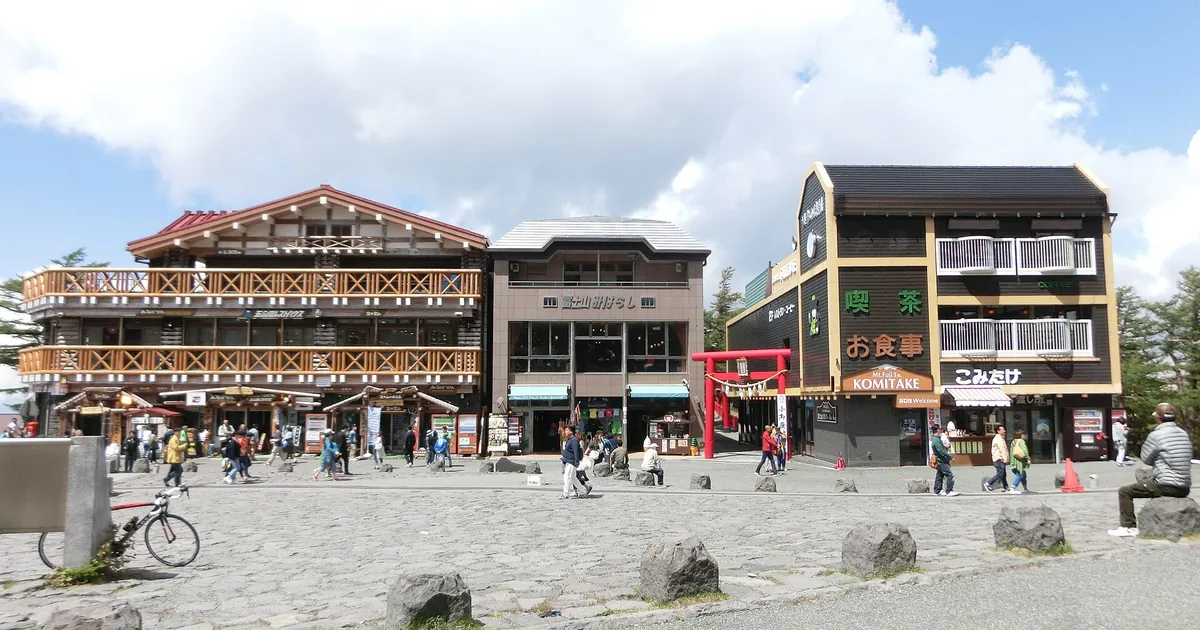
The Fuji Subaru Line 5th Station sits 2,305 metres up the north side of Mount Fuji, at the top of a toll road, and a large share of the people standing on it have no plans to climb any higher. It is a compact cluster of rest houses, restaurants and souvenir shops around a bus rotary, with a shrine founded in 937, a post office twinned with Switzerland’s Jungfraujoch, and, on a clear day, the Fuji Five Lakes spread out below a sea of cloud. On a cloudy day it is a cold car park full of tour buses. Which of those you get is mostly a matter of the forecast. Whether you can get there at all is a matter of the calendar: the upper road depends on snow, and private cars are banned from it through the summer climbing season.
Check Availability
Where it is, and which 5th Station you mean
The Fuji Subaru Line 5th Station (富士スバルライン五合目), also called the Yoshidaguchi 5th Station or the Kawaguchiko 5th Station, stands at 2,305 m (7,562 ft) on Mount Fuji’s northern slopes in Yamanashi Prefecture. That is roughly the halfway point of the Yoshida climbing trail and about 61% of the way up the 3,776 m mountain. You reach it on the Fuji Subaru Line, a scenic toll road that opened in 1964 and climbs the lower northern slopes from Fujikawaguchiko town. Japan-guide ranks it the most popular of the mountain’s four 5th Stations, and “the best developed and easiest to access by public transportation from Tokyo.”
There are four 5th Stations, one for each climbing route, and the difference matters before you book. The Subaru Line station on the Yamanashi side is the one almost every Tokyo day-tripper means. It has the most facilities, and japan-guide describes it as the only one with daily bus service for most of the year. The Fujinomiya 5th Station on the Shizuoka side is higher, at around 2,380–2,400 m, but it has far fewer facilities and no easy access from Tokyo. The full comparison is further down this page.
Picture a small, compact complex above the treeline. It is not a village of streets. Large rest-house buildings, a shrine and a bus and parking rotary sit tightly around a paved plaza, and the whole thing can be explored on foot in one to two hours.
The rest houses, the food and the post office
Four rest-house and shop complexes make up most of the plaza:
- Gogoen Rest House (五合園レストハウス) — a log-cabin-style building and the shopping and food centre of the station. It houses the post office and the bakery that makes the famous Mt. Fuji melon bread, and sells regional bento (the gogome waraji bento), Yoshida udon, hoto and a wide range of souvenirs: sweets, Mt. Fuji crafts, walking sticks and sake. An exhibit on Fuji’s volcano and nature is attached to the complex.
- Fujisan Miharashi (富士山みはらし) — a shop on the ground floor with a restaurant above, known for “eruption curry” served with Fuji-shaped rice, along with hoto, Yoshida udon and soft-serve ice cream you can only buy here.
- Komitake (こみたけ売店) — a shop and restaurant selling gourmet food and its own souvenirs.
- Fujikyu Unjokaku (富士急雲上閣) — a shop, a restaurant and mountain-hut-style accommodation under one roof.
What to eat. The dishes sightseers come looking for:
- Mt. Fuji melon bread — a Fuji-shaped melon pan topped with cocoa and powdered sugar to look like lava and snow, baked at the Gogoen Rest House.
- Eruption curry (噴火カレー) — Fuji-shaped rice with a “lava” of curry, about ¥1,700 at Miharashi and, by some accounts, more photogenic than gourmet.
- Yoshida udon — thick, very chewy regional noodles with horse meat and cabbage.
- Hoto — flat noodles in a miso stew.
- Fuji-themed ramen and local craft beer.
The post office. The Mt. Fuji 5th Station post office operates inside the Gogoen Rest House at 2,305 m and is described as among the highest post offices in Japan. According to the Grand Tour of Switzerland in Japan project, “On July 1, 1993, Japan Post’s Fuji-san 5th Station Post Office (2,305 meters) and the Postbüro Jungfraujoch (3,454 meters), respectively Japan’s and Europe’s highest, signed a mountain postal office alliance.” A genuine yellow Swiss postbox stands in the office as a token of the twinning. Buy a postcard, have it stamped with the exclusive Mt. Fuji postmark and post it home. The office opens seasonally. Do not confuse it with the summit post office, which is higher still and opens only briefly during the climbing season.
Komitake Shrine, the viewpoints and the practical facilities
Komitake Shrine. Fujisan Komitake Shrine (富士山小御嶽神社), directly behind the shops, was founded in 937 (Shōhei 7) on the summit of the ancient Mt. Komitake, an older volcano that modern Fuji grew over and swallowed. For more than a thousand years it has been revered as a guardian of climbers, with blessings for long life, safe childbirth, matchmaking and safe passage, and legend calls the surrounding area the “garden of the Tengu”. An observation point behind the shrine gives an open view over Fujiyoshida City and Lake Yamanaka. The Kaizansai mountain-opening festival is held here early in the morning on 1 July.
Observation points. There are viewpoints at the station, including around the Yamanashi Prefectural Mt. Fuji 5th Station Center and at the shrine. On a clear day the panorama takes in the Fuji Five Lakes, the Southern Alps, the Yatsugatake range and the Asagiri Plateau, and in the right conditions a sea of clouds (unkai) fills the valleys below you.
Other facilities:
- Coin lockers, used by climbers to leave bags, plus public toilets, vending machines and car parks.
- Shops selling climbing supplies: wooden hiking sticks (kongōzue, about ¥1,500–2,000), snacks, bottled water and canned oxygen.
- Horse and pony rides out to some of the nearby scenic spots.
- A first-aid centre during the climbing season, one of three on the Yoshida Trail along with the 7th and 8th Stations. The Mt. Fuji 5th Station General Management Center coordinates rescue calls on 0555-72-1477.
- On the drive up, a “musical road” section plays a tune as your tyres pass over it.
Staying overnight. There is no large hotel at the station. Mountain-hut-style rest houses such as Fujikyu Unjokaku take overnight guests, mostly climbers who want to sleep at altitude before they set off, and some listings describe “three hotels” (rest-house lodgings) and gear rental at the station. Most visitors stay down in the Kawaguchiko and Fuji Five Lakes area instead; our Lake Kawaguchiko guide covers where to stay by shore.
A visit without climbing: what you do, and is it worth the trip?
A sightseeing visit usually lasts one to two hours, which happens to be the same window climbers are told to spend acclimatising. A realistic sequence: browse the plaza and the shops, walk up to Komitake Shrine and its viewpoint, eat (melon bread and a hot bowl of udon, hoto or eruption curry), post a postcard, buy a branded walking stick or a souvenir, take your photographs, and walk a short section of the Ochudo Trail if time and weather allow.
Short walks that do not involve climbing:
- The Ochudo Trail (お中道). A near-level path that circles the mountain at a roughly constant height of about 2,300 m. A section of about 5 km runs west from the 5th Station, and the popular out-and-back to the Oniwa and Okuniwa nature areas is about 6 km round trip and takes 2 to 3 hours, through alpine plants: rhododendrons from mid-June into July, golden larches in October. The route was once a pilgrimage path reserved for those who had already reached the summit three times. It is open from about early May to early November.
- The walk to Satomidaira, for wide views over Lakes Kawaguchi and Yamanaka and the Japan Alps.
- The short stroll up to Komitake Shrine and its observation deck, the minimum walk almost everyone does.
Is it worth it? Recent traveller reports agree: it is worth it on a clear day and underwhelming in cloud. The rewards are real — the scale of the mountain up close, the cool clean air, the feeling of standing on Fuji itself, and views above the clouds. The downsides visitors raise again and again: it gets very crowded with tour buses, so photographs without strangers in them are hard; it can be cold, windy and misty with no view of the mountain at all; and you are always watching the clock, because you are tied to bus times. One local write-up concluded that the station suits people who “want to experience Mt. Fuji up close without committing to a full climb”, and that anyone hoping to sit quietly with the scenery should come early on a weekday, ahead of the tour buses. Since the bus from Kawaguchiko takes about two hours there and back (longer from Tokyo), the trip pays off best when the forecast is clear. If the mountain is hidden, you will see more from a lakeside viewpoint lower down; our guide to the best places to see Mount Fuji ranks them.
Altitude, weather and what to wear
- Elevation: 2,305 m (7,562 ft), above the treeline.
- Temperature: roughly 12°C colder than the lowlands, since air cools by about 0.6°C for every 100 m of height. July averages around 13°C at the station, similar to April in Tokyo, and the summer daytime average is often given as around 15°C. In the autumn-colour season, early to late October, expect highs near 9°C and lows around 1°C. Wind and rain make it feel far colder.
- What to wear, even in summer: a warm jacket or an extra layer over short sleeves, and rain protection. Wear sturdy shoes if you plan to walk the Ochudo Trail. UV is stronger at altitude, so sunscreen and a hat matter even on a cool day.
- Altitude sickness: sightseers who stay at station level are usually fine, but going up fast by bus from near sea level can bring on mild symptoms in some people — headache, dizziness, nausea or shortness of breath. Spend 30 to 60 minutes or more at the station before going higher (climbers are advised one to two hours), drink plenty of water, avoid alcohol and heavy meals on arrival, and go down if symptoms get worse. Canned oxygen is sold at the station and in the huts and can help, but descending is the only reliable treatment.
When the road is open
The Fuji Subaru Line is officially a year-round road, but the section up to the 5th Station depends on snow.
- Spring reopening. For 2026 the full road to the 5th Station reopened at 9:00 on Saturday 18 April, according to a Yamanashi Prefecture press release; in 2025 it reopened on 10 April. Through the winter, snow had limited vehicles to the lower car parks.
- Winter. Heavy snow closes the upper road for long periods. In the 2025–26 winter, the last day the 5th Station could be reached before the road was cut back to the lower car parks was 18 January 2026, according to Yamanashi Prefecture. Some car-park toilets, at Jukaidai and Okuniwa, close in winter because their water pipes freeze. While snow limits the road, the 5th Station is effectively out of reach and its shops cannot serve visitors. The Gogoen Rest House aims to stay open until 16:00 even in winter, but may close on snowy or icy days. No single official document lists each shop’s winter calendar; check before an off-season trip.
- The climbing season: 1 July to 10 September 2026 on the Yoshida Trail. Private cars are banned from the Subaru Line, in 2026 from 18:00 on 3 July to 18:00 on 10 September. Visitors take the route bus from Kawaguchiko or Fujisan Station, or the shuttle from Fujisan Parking. This is the busiest and most crowded time at the station.
- Road open, outside the climbing season: roughly mid-April to June, and mid-September to October. Private cars can drive up. This is the best window for a calmer visit, with autumn colour in October if the weather cooperates.
- Buses. The Subaru Line 5th Station is described by japan-guide as the only 5th Station with daily bus service for most of the year, except when snow closes the road. Sources disagree on how much of that service runs outside the climbing season (see the caveats below). Check the timetable before you plan around it.
The four 5th Stations compared
| Station | Elevation | Trail and side | Facilities and crowds | Best for |
|---|---|---|---|---|
| Fuji Subaru Line | 2,305 m | Yoshida (Yamanashi, north) | Most developed; very crowded; buses for most of the year | Sightseers, families, first-time climbers |
| Fujinomiya | ~2,380–2,400 m | Fujinomiya (Shizuoka, south) | Highest start and shortest route to the summit; a basic shop and restaurant; closes off-season | Experienced climbers who want the shortest ascent |
| Subashiri | 1,970 m | Subashiri (Shizuoka, east) | Forested and quiet; two small shops, no first-aid centre; limited off-season | A quieter climb through forest |
| Gotemba (Shin-Gotemba) | 1,440 m | Gotemba (Shizuoka, south-east) | Lowest start, with the longest and hardest route; few huts; the “Mt. FUJI TRAIL STATION” information centre with an observation deck | Advanced climbers; the sand-running descent |
The Subaru Line station takes most of the tourist traffic because it combines the easiest access from Tokyo — a direct highway bus and a short local bus from Kawaguchiko — with the most facilities and buses for most of the year. The Shizuoka-side stations largely shut down outside the climbing season and are harder to reach without a car.
The Yoshida trailhead, the gate and the permit
The climb to the summit starts here and zigzags up the north-eastern slope on wide, rocky switchbacks. The ascent takes roughly 5 to 7 hours and the descent 3 to 5. The trail passes ceremonial torii gates and a small shrine where climbers pray for a safe ascent.
Since June 2024, Yamanashi has run a gate and checkpoint at the Yoshida trailhead, where the climbing fee is collected and a QR-code permit is scanned. The gate closes overnight to anyone without a mountain-hut reservation, mainly to stop dangerous overnight “bullet climbing”: in 2024 it closed from 16:00 to 03:00, and for 2026 the closure was reported as 14:00 to 03:00. For 2026 the climbing fee is ¥4,000 on all four trails, with a daily cap of 4,000 climbers on the Yoshida route and advance online booking strongly advised. The fee and the booking apply to people passing the gate to climb; visiting the 5th Station as a sightseer does not require either. Full climbing logistics are a subject of their own; our day-trip planning guide summarises the 2026 rules.
Crowds and when to go
Crowds peak in the climbing season, above all during the school holidays from late July to the end of August and in Obon week in mid-August. The Yoshida Trail is by far the busiest route: of the 221,000 people who climbed Mount Fuji in 2023, 62% used it, according to Japan’s Ministry of the Environment as reported by Nippon.com. Total climber numbers have eased a little since the pandemic peak — the Ministry counted around 178,000 climbers in the 2024 season, against more than 200,000 the year before, according to AFP. At the 5th Station itself, sightseeing tour buses drive the crush as much as climbers do.
For a calmer visit, go early on a weekday, before the tour buses arrive at around 9:00, and in the shoulder months of spring and October. Seats on the local bus from Kawaguchiko cannot be reserved and buses back down fill in order of arrival, so queues for the return bus can build at busy times; leave a buffer. Note too that in the off-season the last direct bus from Shinjuku can arrive at the 5th Station as early as 12:10. The measures now in place to manage congestion include the summer car ban, the trailhead gate and daily cap, and the higher toll.
What changed in 2025 and 2026
- The climbing fee is ¥4,000 on all four trails for 2026, up from the 2024–25 arrangement on the Yoshida Trail of a ¥2,000 fee plus a voluntary ¥1,000 donation.
- The toll went up. On 1 October 2025 the Subaru Line toll for a regular car rose from ¥2,100 to ¥2,800 return, payable in cash or coupons only, with no credit cards or ETC. Japan-guide confirms the ¥2,800 figure and notes that the road “is closed to private vehicles during most of the climbing season (July 3 to September 10, 2026).”
- The Mount Fuji railway plan was scrapped. On 18 November 2024 Yamanashi Governor Kotaro Nagasaki cancelled the long-debated light-rail line up the Subaru Line, a project estimated at roughly ¥140 billion (about US$900 million), after a petition of about 70,000 signatures from local residents. In its place is a proposed “Fuji Tram”: a rubber-tyred vehicle guided by magnetic markers and white lines, powered by green hydrogen, intended to carry up to about 1,200 visitors an hour and one day to connect with the future Linear Chūō Shinkansen station. It is still a proposal and nothing has been built.
- The gate and permit system at the Yoshida trailhead, first installed in June 2024, continues.
Getting there, and doing it on a tour
By public transport from Tokyo. Take the direct highway bus from Shinjuku to the 5th Station (about 2.5 hours, reserved seats), or a train or bus to Kawaguchiko followed by the Fujikyuko local bus, which takes about 50 minutes and costs ¥2,000 one way or ¥3,400 return with unreserved seating. Our Tokyo-to-Fuji transport guide prices every leg.
By car. Outside the climbing season, budget the ¥2,800 return toll in cash. During the climbing season, park at Fujisan Parking and take the shuttle.
On a private tour. The Luxury Land Cruiser day tour from Tokyo builds its route around the 5th Station, alongside Oshino Hakkai and the Chureito Pagoda, in a premium vehicle over twelve hours. It rates 4.80 stars from 263 reviews at $348 for the vehicle, and there is a full breakdown here. The Mount Fuji Private Tour With English Guide lists the Subaru Line 5th Station among its stops when the road is open, and is the most-reviewed Fuji-only private day on the site at 4.94 stars from 666 reviews and $309, broken down here. Between 3 July and 10 September a private car cannot drive the Subaru Line, so ask the operator how they handle the shuttle before booking a summer date with the 5th Station in mind; our private versus group comparison covers what that means in practice. GetYourGuide also sells a private 5th Station and Shiraito Falls tour, though it rates 4.78 stars from only 16 reviews, which is too few to call it proven.
If you are staying at the lakes, note that the Kawaguchiko private tour with a local guide (4.99 stars from 52 reviews, $471) does not visit the 5th Station. Take the bus up on a separate half-day.
By coach. The Mt Fuji 5th Station and Hakone Cruise bus tour pairs the station with a Lake Ashi cruise and a bullet-train return to Tokyo, at 4.42 stars across 5,327 reviews and $151. Its rating sits below the private tours above, and combined tours sometimes swap the 5th Station for another stop when the road is closed or congested. Check your date’s itinerary; our Mount Fuji and Hakone in one day guide explains when that happens.
What we would do
Decide whether to go at all by the forecast. The view is most of the reason to come. If a reliable forecast shows clear skies at altitude, go; the view above the clouds justifies the trip. If Fuji is forecast to be under cloud, postpone, or go to a lower lakeside viewpoint instead, because the 5th Station in mist is little more than a cold, crowded car park. Our Mount Fuji visibility guide explains how to check on the morning.
Then plan it in stages:
- Choose your season. For the calmest and cheapest visit with the best chance of views, aim for late April to June, or October: the road is open, private cars are allowed, and October brings autumn colour. For the full atmosphere, with climbers about and every facility open, come in July or August, and expect crowds and the private-car ban.
- Choose your transport. Without a car from Tokyo, the simplest options are the direct Shinjuku–5th Station highway bus (about 2.5 hours, reserved) or a train to Kawaguchiko plus the local bus (about 50 minutes on Fujikyuko Bus, ¥2,000 one way or ¥3,400 return, unreserved). If you are driving outside the climbing season, budget the ¥2,800 return toll in cash. During the climbing season, park at Fujisan Parking and take the shuttle.
- Go early. Aim to arrive by mid-morning on a weekday, to beat the tour buses and to improve your odds of a clear view before the afternoon cloud builds.
- Pack for a mountain, not a city. Warm layers, a rain shell, sunscreen and water, and comfortable shoes if you will walk the Ochudo Trail.
- Allow one to two hours. The shrine, the viewpoint, a meal, a postcard and a short walk fill that comfortably. Add 2 to 3 hours if you walk the Ochudo Trail to Okuniwa.
- If you are going on to the summit, book the ¥4,000 permit and a hut in advance, use the 5th Station to acclimatise, and note the trailhead gate hours.
Signs you should change the plan:
- A poor visibility forecast at altitude: go to a lakeside viewpoint instead.
- Dates in Obon week or on a summer weekend: expect the biggest crowds, and move to a weekday if you can.
- A snow closure, most likely from late autumn through spring: the 5th Station may be out of reach, so check the toll road’s status the day before.
The caveats that matter
Check every time-sensitive detail before you go. Road opening and closing dates, facility hours and bus timetables change every year and with the weather. Confirm them with the official Fuji Subaru Line toll road site, Fujikyu Bus and the official Mt. Fuji climbing site close to your travel date.
Sources disagree on buses outside the climbing season. This page follows japan-guide in describing daily service to the 5th Station for most of the year, and it mentions a direct Shinjuku bus arriving as early as 12:10 in the off-season. Our transport guide found published operating windows for the direct Shinjuku bus tied to the climbing season, and describes the Kawaguchiko local bus as very limited outside it. Treat off-season service as something to confirm with Fujikyu Bus, not something to assume.
The winter closure moves every year. In the 2025–26 season the upper road shut on 18 January and reopened on 18 April, later than the “roughly December to March” window used elsewhere on this site as a general guide.
Elevation. 2,305 m is the standard, widely cited figure; a few sources round it to 2,300 m. Fujinomiya’s 5th Station is variously given as 2,380 m or 2,400 m.
Prices for tolls, fares, fees and meals are the most recent figures found. Treat them as a guide and reconfirm them.
“Highest post office”. The 5th Station post office at 2,305 m is one of the highest in Japan and is officially twinned with the Jungfraujoch office in Switzerland. The summit post office, open only briefly in the climbing season, is higher, so “one of the highest” is the safer way to describe the 5th Station office.
Winter status for individual facilities is not published as a single official calendar. What is reliable is that the upper road, and so the station, depends on snow, and that specific car-park toilets close in winter because of freezing.
Some points on crowds, the visit and the food come from individual traveller reports and reflect personal experiences on particular dates.
Tour prices are the GetYourGuide starting prices for the specific listings named, and vary by operator, season, group size and inclusions. Ratings and review counts were re-sourced from each listing on 15 September 2026.
Related reading
- Lake Kawaguchiko: the complete visitor guide — the base for the 5th Station bus, and what to do on the lake
- The best places to see Mount Fuji — the lower viewpoints to use when the summit is in cloud
- Is Mount Fuji visible today? — the odds by month and hour, and how to check on the day
- Tokyo to Mount Fuji: the transport guide — every bus, train and driving route, priced
- Best time for a Mount Fuji private tour — how the summer car ban and winter snow shape the year
- Compare all six private Fuji tours — side by side, with live prices
Your Own Car, Your Own Day at Mount Fuji
Rated 4.9/5 by 666 travellers. Hotel pickup in Tokyo, an English-speaking driver-guide, and an itinerary you set yourself — with free cancellation up to 24 hours before.
Check Availability & Book