Hakone Day Trip from Tokyo
Hakone works as a full day trip without Mount Fuji. The classic loop stop by stop, the Free Pass maths, and why the museum and the onsen are the reasons to go.
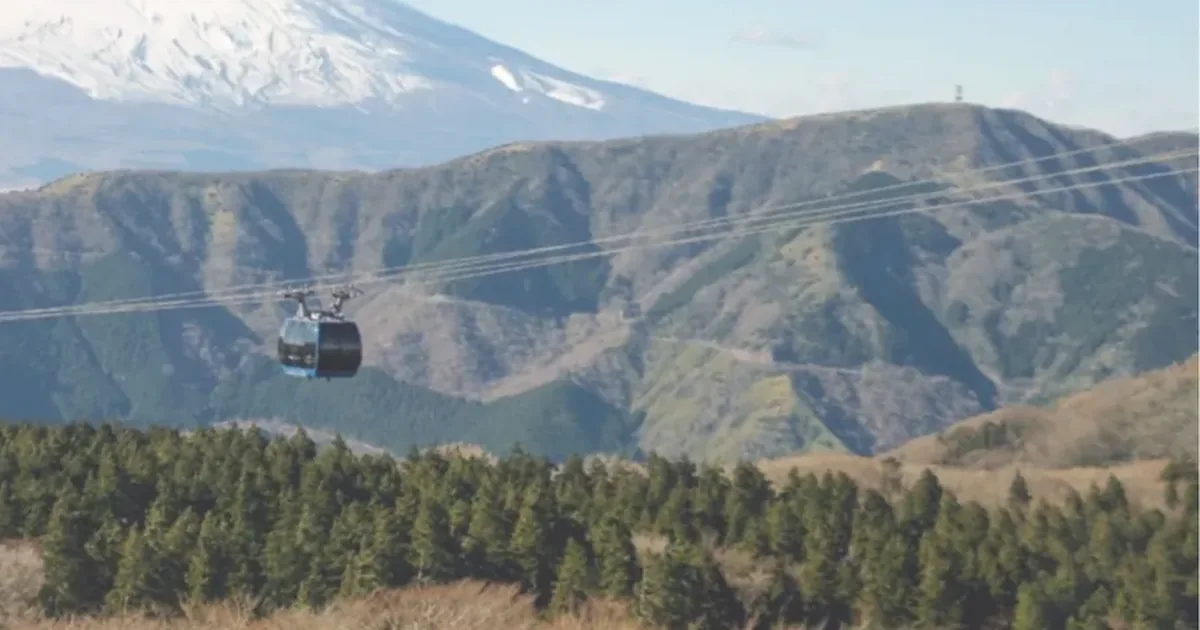
Hakone is the day trip people book because of Mount Fuji and remember for everything else. It sits 80 to 90 minutes from Shinjuku, and what it offers is not a viewpoint but a circuit: a mountain railway that switchbacks up a wooded valley, a cable car, a ropeway over a steaming volcanic crater, a pirate ship across a caldera lake, an outdoor sculpture museum, a reconstructed Edo checkpoint, and hot springs at both ends. Fuji may or may not appear. The day works either way — which is more than a Fuji-focused trip can promise.
Check Availability
Hakone without Mount Fuji: the honest case
Most day-trip guides treat Hakone as the consolation prize for a Fuji trip. One detailed comparison puts the opposite case bluntly, arguing that “a trip to Hakone has more to offer than a trip to Mount Fuji… there are also beautiful shrines, world-class museums and unique volcanic landscapes to enjoy, whereas the typical Mount Fuji hotspots like Fujikawaguchiko have little to offer the visitor aside from Fuji views — which are elusive at the best of times.” For a November trip, our guide to Kawaguchiko or Hakone in November weighs the two side by side.
That is a reasonable case, and it reframes the whole day. If your itinerary depends on the mountain being visible, you are gambling — our month-by-month visibility guide sets out just how badly the odds run in summer. If your itinerary is the loop itself, a cloudy day costs you a bonus rather than the point.
Getting there is straightforward. Roughly 80–90 minutes from Shinjuku on the Odakyu Romancecar limited express, or about 90 minutes from Tokyo Station via the Tokaido Shinkansen to Odawara plus a short connection. Driving via the Tomei Expressway takes about two hours, with the Dangozaka Service Area en route offering a Fuji-viewing stop for drivers. Our transport guide prices each of these properly.
Buy the Hakone Free Pass first
Before planning a route, get the Hakone Free Pass. It is issued by Odakyu, not JR — it cannot be bought or exchanged at JR ticket offices, which catches out Japan Rail Pass holders every week. It covers:
- A round trip on the Odakyu Railway between Tokyo and Odawara at standard fare. The Romancecar limited-express surcharge, roughly ¥1,200 each way, is separate.
- Unlimited use of the Hakone Tozan Railway, Hakone Tozan Cable Car, Hakone Ropeway, the Lake Ashi pirate-ship cruise, and Hakone Tozan / Odakyu buses inside the designated area.
- Discounted or free entry to a number of Hakone attractions and onsen facilities.
It comes as a 2-day or 3-day pass, either covering the Hakone area alone or bundled with the Tokyo–Odawara round trip for a surcharge. One detailed cost comparison concludes that pricing out individual tickets for a full one-day loop — train, Tozan railway, cable car, ropeway, cruise — means you will likely at least break even with the Free Pass. Buy it for the simplicity as much as the saving: one ticket across five transport operators removes the friction that otherwise eats the day.
The Free Pass is an Odakyu product and is not sold through the tour marketplaces, so there is nothing to book here beyond turning up at an Odakyu ticket window. Full ticketing mechanics and the Romancecar’s specifics are in our transport guide; this page is about what to do once you have arrived.
The loop is the point
Unlike most day trips, where you travel out and come back the same way, the classic Hakone Loop is a circle. It can be started from Hakone-Yumoto, Gora, Togendai or Moto-Hakone, run clockwise or anticlockwise, and it always returns you to wherever you began by evening.
That flexibility is genuinely useful. Museum-lovers can reverse the order to reach Gora fresh in the morning; anyone desperate for Owakudani can front-load the ropeway instead; and if you are staying overnight, you start wherever your ryokan is. For a first visit, start at Hakone-Yumoto — the most straightforward arrival point — and run the loop clockwise as described below, which is the most commonly documented and easiest sequence to navigate.
Along the way you ride five different things: Japan’s oldest mountain railway, a cable car, a ropeway over a volcanic valley, a pirate ship, and a bus. For a lot of visitors that variety is as memorable as any single destination — this is one of the more entertaining transit days available in Japan.
The classic one-day loop, stop by stop
Hakone-Yumoto — the starting point and onsen town. Hakone’s gateway and its most convenient hot-spring base, with the easiest access from Tokyo. If you have spare time at either end of the day, Yumoto has numerous day-use onsen facilities — foot baths and full bathing facilities that do not require an overnight stay — plus shops and restaurants along the Sukumogawa riverside.
Hakone Tozan Railway to Gora. From Yumoto, board Japan’s oldest mountain railway for a genuinely scenic ~40-minute ride through a densely wooded valley, over bridges and through tunnels, switching direction three times at switchback points as it zigzags up the mountainside. A novelty in its own right, and a highlight for train enthusiasts and children alike.
Gora and the Hakone Open-Air Museum. Gora is the loop’s second hub and home to the Hakone Open-Air Museum, which is the single best reason to choose Hakone over a Fuji-only trip. It sets 20th-century sculpture outdoors amid nature and mountain scenery — a genuinely different kind of attraction from anything around Kawaguchiko. It rewards unhurried browsing, which is exactly why it is the first thing sacrificed on a combined Fuji-and-Hakone day. A standalone Hakone trip is the format that lets you actually enjoy it.
Cable car and ropeway to Owakudani. From Gora the Hakone Tozan Cable Car climbs to Sounzan, where you transfer to the Hakone Ropeway for the ride over the steaming Owakudani volcanic valley — the region’s most striking natural spectacle. The classic snack stop is the kuro-tamago, black eggs boiled in the valley’s sulfurous hot springs; local lore holds that eating one adds seven years to your life, which is folklore rather than fact.
Ropeway to Togendai, then the pirate ship across Lake Ashi. Continue by ropeway to Togendai on the lake’s northern shore, then board one of the three themed “pirate ships” for a 25–40 minute crossing to Moto-Hakone-ko or Hakone-machi-ko, taking in Fuji on a clear day, the floating torii gate of Hakone Shrine, and the forested shoreline. The Mt. Fuji, Hakone Ropeway, Owakudani and Lake Ashi coach tour packages this central stretch with a coach from Tokyo, rated 4.6 stars from 8,444 reviews and from $54, if you would rather not assemble it yourself. Its listing includes a one-way ropeway ticket, and the Lake Ashi cruise is an optional extra of about ¥1,700 (about $11).
Moto-Hakone and Hakone-machi — the historic southern shore. This end of the loop rewards a slower pace:
- Hakone Shrine, among the cedars, with the lakeside floating torii gate as the signature photograph.
- The Hakone Checkpoint (Sekisho), a meticulously reconstructed Edo-period checkpoint on the old Tokaido highway between Kyoto and Edo. For roughly 250 years this station enforced the shogunate’s famous “no guns in, no women out” travel controls. Rebuilt in 2007; admission runs around ¥500, with discounts for students and children.
- Onshi-Hakone Park, the former imperial detached palace grounds on the promontory between Moto-Hakone and Hakone-machi, with some of the lake’s best Fuji panoramas from its public gardens.
- The southern shore generally is cited as an excellent Fuji-viewing spot in its own right, distinct from the ropeway and cruise vantage points.
The Sekisho is the stop most often skipped, and the only private tour in our inventory that names it is the Hakone Full-Day Private Guided Tour with Pickup, which strings Lake Ashi, the ropeway, Owakudani, Hakone Shrine, the Sekisho observatory and the Gotemba outlets into one chartered day. It rates 5.00 stars, but from only 8 reviews — treat that score as provisional rather than proven.
Back to Hakone-Yumoto and Tokyo. From Moto-Hakone or Hakone-machi, buses connect back to Yumoto to close the loop, or onward to Odawara for the Shinkansen or Odakyu connection home.
Fuji visibility on a Hakone-only day
Even when the mountain is not the plan, it remains a recurring possible bonus throughout the loop — visible on clear days from Lake Ashi, from the ropeway, and from the southern lakeshore around Moto-Hakone and Onshi Park.
One piece of practical wisdom is worth internalising: Fuji’s clouds come and go through the day. If you do not spot it at Owakudani in the morning, you may still catch it an hour later from Moto-Hakone in the afternoon. Do not write the day off after one cloudy viewpoint. Hakone also sits in its own volcanic caldera and generates its own micro-weather, so a clear morning in Hakone is not the same thing as a clear view of a mountain 30 to 40 km away. Our month-by-month visibility guide carries the seasonal odds in full, and our viewpoint guide explains why Hakone’s Fuji views are more distant and more weather-dependent than the Five Lakes'.
Onsen — Hakone’s other headline draw
Beyond the loop’s sightseeing, Hakone is fundamentally an onsen destination, and even a single day trip can include a soak. Hakone-Yumoto in particular has numerous day-use bathing facilities that do not require an overnight ryokan stay, which makes it realistic to bookend the loop with a bath before heading back to Tokyo. A Fuji-focused day trip simply does not offer this in the same way.
If you want the soak built into a chartered day rather than squeezed in around a train timetable, the private Fuji and Hakone tour with onsen, art and nature is the only product in our inventory that includes an onsen stop alongside Lake Ashi and the Hakone Shrine — 5.0 stars from 148 reviews, $316 per person.
How to book it: coach, private car, or do it yourself
Do it yourself with the Free Pass. The cheapest and most flexible option, and the one the loop is designed for. You control the pace, linger at the museum, and the pass removes the ticketing friction. The cost is planning time and rigid last trains.
A coach day tour hands the whole thing over. The Mt. Fuji, Hakone Ropeway, Owakudani and Lake Ashi coach tour is the highest-volume product of the type at 4.6 stars from 8,444 reviews and around $54, covering the loop’s central stretch with the transport from Tokyo bundled in. If you would rather not sit on a coach for the return leg, the Mt Fuji 5th Station and Hakone Cruise bus tour ends with a bullet-train run back to Tokyo at 4.4 stars across 5,368 reviews, $151, and the Mt. Fuji and Hakone tour with a Shinkansen return does the same for $115 — though at 4.2 stars from 1,768 reviews it is the lowest-rated product named on this page, and the reviews that drag it down cite the pace rather than the route.
A private car is the format that adapts. Beyond the onsen tour above, the Hakone Private Tour: Bespoke Day from Your Hotel is the only genuinely Hakone-only private product in our inventory — eight hours from your hotel taking in the ropeway, a Lake Ashi cruise and Hakone Shrine. It is worth being straight about its numbers: it rates 4.36 stars from 35 reviews, the weakest score of any tour on this site, and it has slipped since we last checked. We list it because it is the only chartered day that stays in Hakone rather than splitting the day with Fuji, not because it is the best-rated thing here — read the recent reviews before booking.
A combined Fuji-and-Hakone day is a different trip with a different trade. The Mt Fuji and Hakone Private Custom Tour with English Driver is the most-booked version at 4.8 stars from 807 reviews, $315, with a full breakdown here, and the Mt. Fuji and Hakone coach tour taking in Arakurayama, Oshino Hakkai and Owakudani does both sides for $49 at 4.8 stars from 628 reviews. Before you book either, read our honest guide to doing Fuji and Hakone in one day — the Open-Air Museum is almost always the casualty, and this page exists precisely because that stop deserves better.
What we’d actually do
Take the Romancecar from Shinjuku, buy the Free Pass, and run the loop clockwise from Hakone-Yumoto. Give the Hakone Open-Air Museum a real two hours rather than a hurried thirty minutes, and give the shrine and checkpoint around Moto-Hakone the same courtesy. Those two stops are what a standalone Hakone day buys you over the combined version.
Front-load the ropeway and Owakudani for the morning light, and keep the southern lakeshore — Moto-Hakone and Onshi Park — as the afternoon fallback if the morning cloud clears later. That way a Fuji sighting is a bonus twice over rather than a single roll of the dice.
Bookend it with a bath. Twenty minutes in a Yumoto day-use onsen before the train home is the difference between a good day out and the reason people come back to Hakone.
The caveats that matter
Prices are deliberately general. The Hakone Checkpoint’s ~¥500 admission and the Romancecar’s ~¥1,200 each-way surcharge are illustrative figures from current sources; verify exact pricing before booking, especially given periodic fare revisions.
Fuji visibility is never guaranteed on any Hakone itinerary. Treat a sighting as a bonus, not the basis of the plan.
Crowds are a real factor, especially on public transport in peak season. Hakone’s popularity and its proximity to Tokyo mean weekends and holiday periods run considerably busier than a weekday.
This is the classic loop, not the whole of Hakone. There are more museums, hiking trails and further onsen towns than a single day can cover — consider an overnight stay if you want to go beyond this core itinerary.
Ropeway and cruise mechanics are summarised here rather than exhaustive, and the case for and against combining Hakone with a Fuji day is made properly in our Fuji and Hakone in one day guide.
Tour prices are the live GetYourGuide starting prices for the specific listings named, and vary by operator, season, group size and inclusions. Ratings and review counts were re-sourced from each listing on 12 September 2026.
Related reading
- Mount Fuji and Hakone in one day — what the combined version cuts, stated honestly
- Chureito Pagoda: the complete visitor guide — the Fuji-side icon, if you would rather have the mountain
- The best places to see Mount Fuji — where Hakone ranks among the alternatives
- Tokyo to Mount Fuji: every way to get there — the Romancecar, the Free Pass and the rest
- The best time for a Mount Fuji private tour, month by month — when a Fuji bonus is actually likely
- Compare all six private Fuji tours — side by side, with live prices
Your Own Car, Your Own Day at Mount Fuji
Rated 4.9/5 by 675 travellers. Hotel pickup in Tokyo, an English-speaking driver-guide, and an itinerary you set yourself — with free cancellation up to 24 hours before.
Check Availability & Book