Mount Fuji and Hakone in One Day
Can you really do Mount Fuji and Hakone in one day from Tokyo? What a combined day actually delivers, what it cuts, and when to pick one instead.
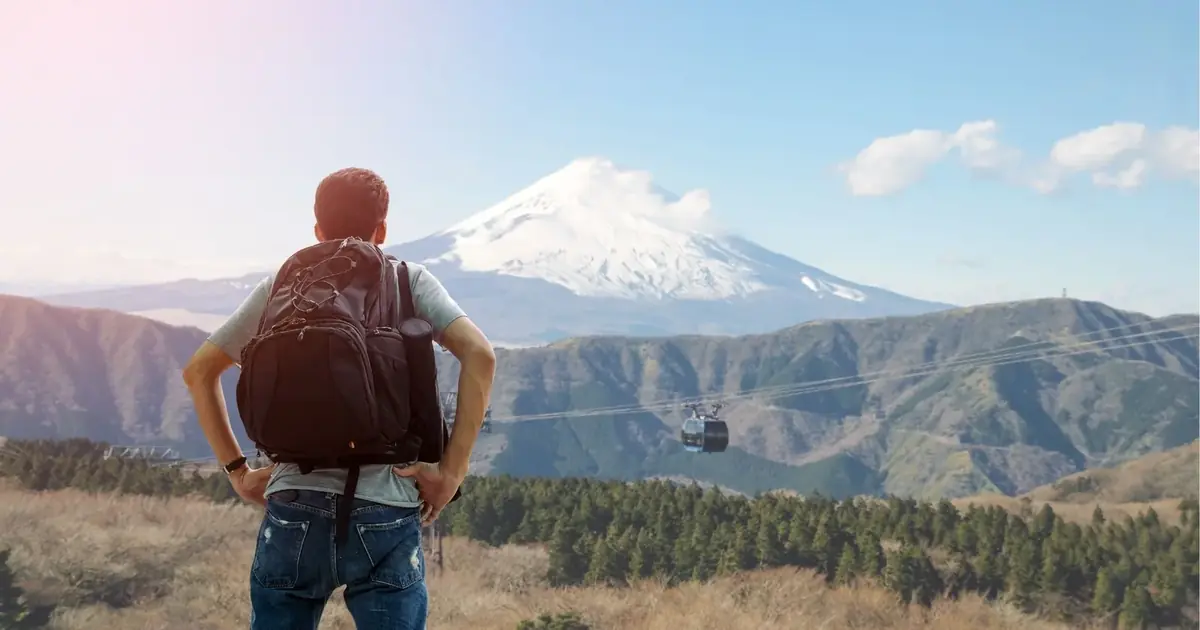
Yes, you can see Mount Fuji and Hakone in a single day from Tokyo, and thousands of people do it every week. The two areas sit only about 30 miles apart — roughly 50 to 55 km by road, an hour’s driving through Gotemba — so linking them is geographically sensible. The catch is what the day becomes: a greatest-hits sampler, ten to twelve hours door-to-door, with one or two highlights at each place rather than the four to six you would get doing either alone. That is a real trade, and it is worth making with your eyes open.
Check Availability
Feasible, popular, and honestly a sampler
Geographically the pairing makes sense. Kawaguchiko and Hakone are about 30 km apart in a straight line and 50–55 km by road, and the drive takes 53 to 75 minutes depending on your exact endpoints and the traffic, via Gotemba on National Route 138. They are neighbours on the flanks of the same volcanic region inside Fuji-Hakone-Izu National Park, which is why so many operators sell the combination.
The honest consensus among experienced guides, though, is that one day is a rushed proposition. Tokyo Cheapo notes that even Hakone alone is better unhurried — “we recommend not burning yourself out and staying overnight instead. After all, Hakone is a place people go to relax.” A Tripadvisor forum regular puts the combination bluntly: “combining this with Kawaguchiko / Fifth Station / Gotemba activities will involve a lot of unproductive travel time.” A veteran local guide writing on GoWithGuide is blunter still about the do-it-yourself version: “one day trip from Hakone to Mt.Fuji by public transportation is not so realistic, as there is no efficient public transportation between them.”
So: feasible and popular, but a sampler. You trade depth for breadth. If ticking both icons matters more than lingering at either, it works. If you want to linger, it will frustrate you.
The most-booked way to do it properly is a chartered car, because it is the only format that can re-order the day around the weather: the Mt Fuji and Hakone Private Custom Tour with English Driver runs 10 to 11 hours at 4.8 stars from 807 reviews, $315 for a small group, and there is a full breakdown of its itinerary here.
What a combined day actually looks like, hour by hour
Commercial Fuji-and-Hakone tours are remarkably consistent in shape. A representative full day:
- 7:15–9:00 AM — depart Tokyo. Shinjuku is the near-universal meeting point; some tours use Tokyo Station. One widely sold tour meets at 7:15 and departs 7:30; the classic coach products start around 8:00–9:00. The drive to the Fuji area is roughly two hours.
- Late morning — the Fuji-area stop or stops. Historically the Fuji Subaru Line 5th Station at about 2,300 m. Increasingly, tours substitute or add lower viewpoints: Oshino Hakkai, the spring-fed pond village with Fuji behind it; Lake Yamanaka’s Shiratorihama, the “Swan Beach”; Lake Kawaguchi and Oishi Park; or the Fujisan World Heritage Centre.
- Midday — lunch near Fuji, commonly a Japanese buffet with a mountain view, usually included in packaged tours.
- Early to mid afternoon — transfer to Hakone via Gotemba, about an hour, sometimes with a stop at the Gotemba Premium Outlets. Per japan-guide.com this is “Japan’s most popular outlet mall” — around 300 stores and restaurants, a food court, a hotel and a public hot-spring bath, open since 13 July 2000.
- Afternoon — the Hakone core. The Hakone Ropeway over the steaming Owakudani volcanic valley, where you try the black eggs, then a Lake Ashi cruise on a “pirate ship” past Hakone Shrine’s floating torii gate. The kuro-tamago are wrapped in local folklore; as one Owakudani vendor told National Geographic, “talking about living seven years longer while eating black eggs is an essential part of the Owakudani experience” — though there is no science behind the longevity claim, and per that same vendor the supposed benefit “maxes out after two eggs”.
- Late afternoon and evening — return to Tokyo, either by coach (about two hours back to Shinjuku) or by bullet train from Odawara Station. Tours advertising the train return typically end 10 to 11 hours after they start. A realistic return is 6:30 to 8:00 PM.
The best-known version of the coach format is the Mt Fuji 5th Station and Hakone Cruise bus tour with a bullet-train return — 4.4 stars across 5,368 reviews at $151, which is the “everything handled, ends with a Shinkansen” shape described above. Its rating sits below the private tours on this page, which is what a fixed-timetable coach day tends to produce.
Fuji first or Hakone first?
Most tours go Fuji first, Hakone second, and that is the better order. Fuji-area viewpoints are at their best in the morning before cloud and haze build, and Gotemba sits naturally between the two, so you sweep Fuji → Gotemba → Hakone → Tokyo without doubling back. A minority of tours reverse it to reach Lake Ashi before the afternoon boat crowds; that can work, but it fights the visibility clock.
Will you actually get the 5th Station?
Frequently not, and there are three separate reasons.
First, the Fuji Subaru Line closes in winter, roughly mid-December to late March or early April, for snow and ice. Tours then substitute a snow resort at the 2nd Station, or Oshino Hakkai.
Second, during the summer climbing season private vehicles are banned on the Subaru Line under the My Car Regulation. Per japan-guide.com the road is closed to private vehicles “during most of the climbing season (July 3 to September 10, 2026), during which shuttle buses operate between designated parking lots at the base of the mountain and the 5th station” — which forces a time-eating transfer into an already tight day. The Yoshida trail itself is scheduled to open on 1 July in 2026, earlier than its usual 10 July, per the official fujisan-climb.jp site.
Third, operators cite traffic congestion and hill-climb events on specific 2026 dates as reasons to swap the 5th Station out. Several combined itineraries skip it entirely in favour of lakeside and village viewpoints that photograph better and cost less time.
The practical rule: do not book a combined tour assuming you will stand at the 5th Station. Treat it as optional and check what your specific date’s plan actually is.
What you have to sacrifice
The combined day is defined by what it cuts. Doing each area separately you would get three to five stops at each. Combined, you compress to roughly this:
| What you’d get on a dedicated day | What the combined day gives you |
|---|---|
| Fuji area: 3–5 stops — Chureito Pagoda, Kawaguchiko and Oishi Park, Oshino Hakkai, the 5th Station, Iyashi-no-Sato, the ice caves | One or two — usually a single viewpoint or the village |
| Owakudani: 45–90 minutes, enough to walk the reserved nature trail | A ~40-minute pass-through: the view, a photo, a black egg |
| Hakone Open-Air Museum: about 2 hours, and worth every one | Almost always cut. The single most common casualty |
| Onsen or ryokan time | Cut entirely. Hakone’s whole identity, and there is no room for it — see our standalone Hakone day |
| Chasing clear weather | Cut. One fixed mid-day window at each place |
Real reviews capture the trade honestly in both directions. One reviewer of a Fuji-and-Hakone bus tour wrote: “You spend around 5 hours total on the bus compared to the 20-30 minutes allotted for each scenic overlook. Way too rushed feeling.” Another: “12 hour day with only 2-3 hours of stops in total… Each stop 30-40 minutes at best so very rushed at every point.”
And yet plenty of travellers accept the pace precisely because it delivers the icons efficiently. One blogger concluded it was “worth it to see Mt. Fuji which I wouldn’t have attempted to do on my own given how relatively far and remote it is,” while praising that the day “didn’t just take us two hours outside of Tokyo to see Mt. Fuji and then get back on the bus.”
The three ways to do it
1. Shared or group bus tour — the default
By far the most common commercial format, and the one every itinerary above describes.
For: everything handled — transport, timing, tickets, often lunch and a bullet-train return. No navigation stress. Cheapest per person. Against: fixed route and timing, large groups, rushed stops, and vulnerability to delays — several tours warn that if traffic puts the bus more than an hour behind, the Gotemba Outlets stop is simply cancelled. Reviews frequently flag over-full boats and “rushed at every point” pacing.
A more Hakone-weighted alternative is the Hakone Ropeway, Owakudani and Lake Ashi coach tour at 4.6 stars from 8,444 reviews and around $54 — the highest-volume product of the type, and a better bet if the forecast means the mountain is unlikely to appear.
2. Private car and driver
A private driver-guide runs the same geography but lets you flex the order and the dwell time and — crucially — redirect toward clearer weather or backup stops. Where visibility is poor, a driver can swap to the Gotemba Outlets, Oshino Hakkai, local museums, food stops or straight on to Hakone.
Worth knowing: a March 2024 deregulation means licensed guides in Japan may now drive customers during paid tours, which is why more driver-guide products exist than a few years ago.
Tellingly, many private “Fuji and Hakone” products make you choose one area for the day to keep it unhurried — a clear signal that operators themselves consider both in a single private day to be a stretch. Among those that do run both, the Private Mount Fuji and Hakone Customizable Tour rates highest at 4.9 stars from 134 reviews, $337, with the Mount Fuji and Hakone Full Day Private Tour at 4.8 from 64 reviews as the smaller alternative.
For: flexibility, door to door, fewer transfers — which matters for families, older travellers and anyone with mobility needs. Against: substantially more expensive, and still a long day if you insist on both.
3. Self-guided DIY
Technically possible, genuinely hard. There is no single direct train or bus between Kawaguchiko and Hakone; you connect through Gotemba. Per japan-guide.com the public route is the Odakyu Highway Bus from Togendai or Sengoku in Hakone to Gotemba Station (25–35 minutes, ¥790–1,080, about two an hour), then the Fujikyu Bus from Gotemba to Kawaguchiko (one hour, ¥1,750, one to two an hour). Total transfer time is roughly two to two and three-quarter hours door to door — and that is before you do any sightseeing in either area, each of which is a full day in itself.
No single pass covers the chain neatly, either: the Hakone Free Pass covers the Odakyu bus only as far as Gotemba, not the Fujikyu leg. Only the pricier Fuji Hakone Pass covers both. Forum consensus and local guides agree: doing both by public transport in one day is not realistic. You will spend the day on buses rather than at viewpoints. DIY makes sense only split across two days, or with a night in one of the two areas.
Our transport guide covers the Romancecar, the Hakone Free Pass, the Fuji Hakone Pass, fares and timetables in full. The point here is narrower: the connection exists via Gotemba but it is slow, which is exactly why the combined trip is overwhelmingly done as a guided tour.
Route logic and geography
- Order: Fuji first in the morning, Hakone in the afternoon. Fuji visibility is best early; cloud and haze build through the day.
- Midpoint: Gotemba. It connects to Kawaguchiko by Fujikyu bus in about an hour and to Hakone by Odakyu Highway or Hakone Tozan bus in 25 to 35 minutes, and it hosts the Premium Outlets — a logical and commercially convenient pivot.
- Driving times worth knowing: Kawaguchiko to Hakone is about 54 minutes to 1h15 across roughly 50–55 km via Route 138 through Gotemba. Kawaguchiko to Hakone-En or Hakone-Yumoto is around an hour by car.
- Never backtrack through Tokyo. You do not need to return to the city between the two — the Gotemba corridor links them directly. A tour or a car that routes you back through Tokyo is wasting hours of your day.
The weather problem, stated plainly
This is the single most important caveat, and it is specific to the combined day.
Hakone’s Fuji views are more distant and more weather-dependent than Kawaguchiko’s. From Hakone the mountain sits 30 to 40 km to the northwest — close enough to be spectacular on a clear day, framed by Lake Ashi’s torii, Owakudani’s steam, or seen from the ropeway or the Komagatake summit, but far enough that atmospheric conditions matter enormously. Hakone also sits inside a volcanic caldera and generates its own weather, which can obscure Fuji independently of conditions elsewhere. A clear morning down in Odawara is no guarantee of a clear mountain 700 m higher at Lake Ashi.
Three visibility facts make this hard for a one-day combination:
- Morning is best, everywhere. Overnight cooling clears the haze; by midday solar heating drives moist air upward and cloud forms around the summit. Visibility trackers consistently score mornings markedly higher than afternoons.
- A day trip gives you one mid-day roll of the dice — precisely when cloud is most likely to have built. An overnight stay roughly doubles your odds, because you get an evening, a dawn and a morning instead of a single afternoon window.
- Summer is worst — the June-to-July rainy season and humid August can hide Fuji for days at a stretch. Winter mornings are clearest, but that is exactly when the 5th Station road is shut.
What follows from that. If a clear, close-up Fuji is your number one goal, a combined day is a poor bet — a dedicated Kawaguchiko trip, ideally overnight, does far better. If you treat Fuji as a bonus and want variety — a ropeway, a lake cruise, a volcanic valley, a shrine — the Hakone-weighted combined day is rewarding even when the mountain never shows. Check a visibility forecast the morning you go. Our month-by-month visibility guide sets out which weeks are worth planning around in the first place.
Who it suits, and when not to combine
Combine them if you:
- Are a first-time visitor with only one free day and want the maximum number of icons in it.
- Value breadth over depth and are comfortable with a long, transit-heavy day.
- Want the logistics handled — a guided coach or a private car — rather than solving the transfers yourself.
Pick one, or stay overnight, if you:
- Want the best odds of a clear, close-up Fuji — choose Kawaguchiko and the Fuji Five Lakes, ideally with a night there. The Mount Fuji Private Tour With English Guide, 4.9 stars from 880 reviews at $319, is the Fuji-only version of the private day.
- Want to actually relax — onsen, ryokan, a kaiseki dinner, the Open-Air Museum, the full Hakone Round Course — choose Hakone, ideally overnight. The Hakone Private Tour: Bespoke Day from Your Hotel does the Hakone-only version at 4.5 stars, from only 46 reviews.
- Dislike rushed, on-the-bus days, or are travelling with people who tire easily and would find ten to twelve hours grueling.
- Are relying on public transport and would rather not spend the day connecting through Gotemba.
The strongest framing we found: most visitors do Fuji and Hakone as a long day from Tokyo, and it is a perfectly good day. The problem is that the sky is frequently not kind, and a day trip gives you exactly one roll of the dice, in the middle of the day. One dawn beats three afternoons.
2025 and 2026 conditions to verify before booking
- Volcanic alert level. As of 2026, Mount Hakone’s alert level is Level 1 (normal) per the Japan Meteorological Agency, unchanged since the downgrade of 7 October 2019 — the lowest on the five-level scale. Owakudani has a history of closures during elevated activity, most notably a full closure from May 2015 to April 2016 and a Level-2 closure from 19 May to 16 November 2024, so check the JMA or Hakone Town alert level before you go. A March 2025 revision to the hazard-zone geometry was administrative and did not change the level.
- Owakudani and the black eggs. Open in 2026, with shops running roughly 09:00–16:20. The reserved-group volcanic steam-zone walking tour — reopened 28 March 2022 — still operates at four sessions a day (10:00, 11:30, 13:00, 14:30), 30 people per session, advance reservation, ¥800 cashless safety-cooperation fee. Combined day tours rarely have time for it.
- The Hakone Ropeway. It ran maintenance suspensions with substitute buses in winter 2025–26 (Sounzan–Owakudani 8–19 December 2025 and 13–30 January 2026; Owakudani–Togendai 31 January–20 February 2026) and changed operating hours from 1 April 2026. It is otherwise running normally, with July–August 2026 events, a new “Earth Valley” observation deck at Owakudani station (opened April 2025) and “OWAKUDANI KITCHEN” (opened July 2026). Day-of operation can still be suspended for high wind or volcanic gas, in which case tours substitute a bus — and the ropeway fee is not refunded.
- The Fuji 5th Station. The Subaru Line closes roughly mid-December to late March for snow, with possible partial closures during heavy falls, and the private-vehicle My Car Regulation runs through the summer climbing season, 3 July to 10 September 2026. On regulated or closed dates, expect a substitute Fuji-area stop.
- The Gotemba Outlets stop. Several operators warn it may be cancelled on peak-congestion dates, or if the bus is running more than an hour late.
What we’d actually do
Decide your first priority before anything else. Clear, close-up Fuji: do Kawaguchiko alone, ideally overnight. Relaxation, onsen, art: do Hakone alone, ideally overnight. “See both icons in my one free day”: book the combined tour and accept the pace. This one decision resolves most of the trade-offs below it.
If you are combining, book a guided tour rather than DIY. The Gotemba public-transport connection eats two to two and three-quarter hours of transfers and will consume your sightseeing time. Take a group coach for value, or a private car if you want the flexibility to chase clear weather, have a family or mobility needs, or are a group of three to seven splitting the cost.
Prefer Fuji first, Hakone second, and take the bullet-train return from Odawara if it is offered — it saves the slow evening coach slog back to Shinjuku.
Set your expectations on stops. Assume one or two Fuji viewpoints, about forty minutes at Owakudani, the ropeway and a Lake Ashi cruise. Assume the Open-Air Museum, the extra lakes, the Chureito Pagoda and any onsen are out. If any one of those is a must-do, you should not be combining.
Check three things the morning of, or before booking: the Fuji visibility forecast; the Hakone volcanic alert level and the Owakudani and ropeway status; and whether your date falls inside a 5th-Station closure or a My Car Regulation window.
Three benchmarks that should change the plan. If the forecast is poor — summer haze, rain — lean Hakone-heavy, which is rewarding without Fuji, or postpone. If the alert level rises to 2 or above, expect Owakudani and ropeway disruption and confirm the substitute plan. And if you have two days, split it: Fuji one day with a night at Kawaguchiko for the dawn view, Hakone the next. Almost every expert considers that the materially better trip.
The caveats that matter
Prices are deliberately light here. Tour fares vary widely by operator, season, group size and inclusions; the figures quoted are the live GetYourGuide starting prices for the specific listings named, and everything else should be verified with the operator directly.
Itineraries change. Every tour cited warns that stop order, timing and inclusions are subject to weather, traffic and operational conditions. The structures above are representative patterns, not guarantees.
The time-sensitive items — Owakudani access and the volcanic alert level, Hakone Ropeway status, Fuji 5th Station road openings and My Car Regulation dates, and Gotemba Outlets availability — all change. Confirm on official sources (the JMA, Hakone Town or Hakone Navi, and the Fuji Subaru Line) close to your travel date.
Distance and time figures come from mapping and transit aggregators plus japan-guide.com, and vary with exact endpoints and traffic. Treat them as planning estimates, not schedules.
Ticketing detail lives elsewhere. The Romancecar, the Hakone Free Pass and the Fuji Hakone Pass are covered properly in our transport guide and only summarised here.
Related reading
- Tokyo to Mount Fuji: every way to get there — fares, passes and the routes between the two areas
- Mount Fuji day trip from Tokyo: the complete planning guide — the Fuji-only version of the same day
- Mount Fuji private tours from Tokyo: the complete 2026 guide — every private format, with real prices
- The best time for a Mount Fuji private tour, month by month — when the mountain is actually visible
- Compare all six private Fuji tours — side by side, with live prices
Your Own Car, Your Own Day at Mount Fuji
Rated 4.9/5 by 675 travellers. Hotel pickup in Tokyo, an English-speaking driver-guide, and an itinerary you set yourself — with free cancellation up to 24 hours before.
Check Availability & Book