What to Expect on a Mount Fuji Private Tour
Hour by hour on a private Mount Fuji day tour from Tokyo — drive times, the standard stops, how long you get at each, what to wear and what isn't included.
A private Mount Fuji tour is a long day and a simple one. Roughly ten to twelve hours, about four to five of them in the car, and four or five stops in between — bookended by a pickup outside your hotel and a drop-off at the same door. Here is what actually happens between those two moments.
Check Availability
Before you go
How far is it? Lake Kawaguchiko, the usual base for Fuji sightseeing, is about 110–140 km from central Tokyo — two to two and a half hours by road via the Chuo Expressway in normal traffic. Yes, it is comfortably a day trip; no overnight stay is needed unless you specifically want a sunrise shot.
When will you be collected? Most operators suggest an early start, often between 7am and 8am, and there is a good reason beyond simply fitting more in: the expressway between Hachioji and Otsuki jams on weekend mornings and through the autumn foliage weeks, where delays of two to three hours are not unusual. Haze also builds through the day, so the mountain is usually at its clearest early. If your guide proposes leaving at 6am, take the advice.
What should you bring? Comfortable shoes, layers, some cash in yen, your passport or photo ID, and a charged phone. Layers matter more than people expect — the 5th Station sits at around 2,300 m and runs far colder than Tokyo even in August.
Who your driver-guide actually is
This is the part of the day people most often picture wrongly, and it shapes everything that follows.
Almost every tour on this site is run by a driver-guide rather than by a licensed interpreter-guide travelling alongside a separate driver. The practical difference is real. A driver-guide navigates, chooses and re-orders the stops, translates at restaurants and ticket counters, knows which car park is full on a Saturday, and takes your photograph at the viewpoint. What you will not get is an academic lecture on Edo-period pilgrimage routes at each stop — the commentary is conversational, offered when you ask for it and dropped when you would rather look out of the window.
That is usually the right trade for a sightseeing day. It is the wrong one if the history is the reason you came, in which case look specifically for a listing that names a licensed (national or regional) guide, and expect to pay more for the second person in the vehicle. The Kawaguchiko private tour with a local guide is the clearest example in our inventory — a licensed local guide, on foot, based at the mountain rather than driving out from Tokyo, 4.99 stars from 52 reviews at $471 for six hours, with a full breakdown here.
On language, every tour listed here advertises English. Several operators also cover Hindi, Urdu, Arabic, Russian or Spanish, but that is listing-specific rather than standard — check the individual page if you need something other than English, and confirm it in the booking notes rather than assuming.
One thing worth doing at pickup: say what you actually want from the day out loud. Driver-guides build the route around the brief they are given, and “we mostly want photographs, and we do not mind skipping the shopping stop” is a more useful instruction than they usually receive.
The standard day, stop by stop
Itineraries vary, but almost every Tokyo-departure private tour draws from the same set. Typical timings are taken from the operators’ own published plans.
Pickup, around 07:00–08:00. Your driver-guide meets you at your accommodation. This is the moment to agree the day’s plan — say now if you care most about photography, or want a long lunch, or need to be back by six.
Drive, roughly 2–2.5 hours. Expressway, then the road climbs into Yamanashi. Most vehicles have Wi-Fi; several include bottled water.
Chureito Pagoda, 45–60 minutes. The five-storey pagoda in Arakurayama Sengen Park, with Fujiyoshida spread out below and the mountain behind — the single most recognisable Fuji photograph. Worth knowing in advance: the viewpoint is up roughly 400 steps. There is a gentler switchback path for anyone who would rather not take the stairs, and your guide can skip the stop entirely.
Lake Kawaguchiko and Oishi Park, 45–60 minutes. The north shore has the cleanest sightlines to the mountain and the classic reflection. Oishi Park’s flower beds change with the season — lavender in summer, red kochia bushes in October.
Oshino Hakkai, about 45 minutes. A village of eight spring-fed ponds filtered through Fuji’s lava over decades, ringed by thatched-roof houses and food stalls. Small, busy, and genuinely lovely early.
The Fuji Subaru Line 5th Station, when open. At about 2,300 m, this is the highest point a day tour from Tokyo reaches. See the seasonal warning below — it is not always possible.
Optional stops. Depending on the tour: the Kitaguchi Hongu Fuji Sengen Shrine, Lake Yamanaka, the thatched village of Saiko Iyashi-no-Sato Nenba, Gotemba Premium Outlets, or a crossing into Hakone for the ropeway and a Lake Ashi cruise.
Drop-off, around 18:00–20:00. Back at your hotel, or at Haneda, Narita or a station if you arranged it when booking.
The 5th Station warning
This catches out more visitors than anything else on a Fuji day.
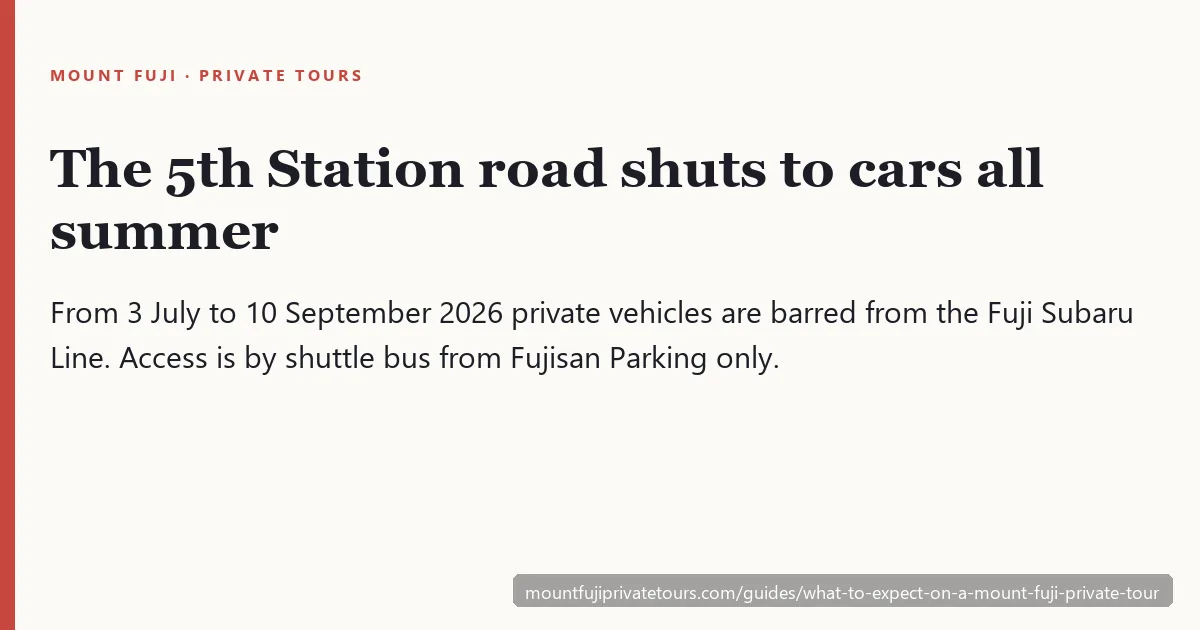
For the 2026 climbing season, private vehicles are barred from the Fuji Subaru Line from 18:00 on 3 July until 18:00 on 10 September, with access by shuttle bus from Fujisan Parking instead. A private car simply cannot drive you up in that window. In deep winter — roughly December to March — the same road can close at short notice for snow and ice.
If the 5th Station is important to you, raise it before you book rather than on the morning, and check what your operator plans to do in the restricted months.
What it is not
It is not a hike. The walking is short strolls at viewpoints, lakeshores and shrines. The Chureito steps are the one real exertion.
It is not a climb. Reaching the 3,776 m summit is an overnight expedition on a season that runs 1 July to 10 September, now governed by a mandatory ¥4,000 entry fee on all four trails, a 4,000-climber daily cap on the Yoshida route, and a gate closed between 14:00 and 03:00 to anyone without a mountain-hut booking. Those rules have changed in each of the last several seasons — check the official Mt. Fuji climbing site rather than a tour page if that is your plan.
It is not all-inclusive. Entry fees, meals and any ropeway or cruise tickets are usually extra. Some operators do bundle fuel, tolls and parking — see the cost guide for what to check.
If the mountain does not show
It happens, and more often than most visitors expect — in the city of Fuji’s 35-year record, taken from the southern side at 8am, the whole mountain was visible on about 10% of July mornings, against about 62% in December. Two things make it survivable.
First, a private itinerary can move. Your guide can reorder the stops toward whatever side is clearest, drop the high viewpoints in favour of lake-level ones, or add a shrine, an onsen or Oshino Hakkai instead. That flexibility is the real argument for the format, as our private-versus-group comparison sets out.
Second, free cancellation up to 24 hours before means you are not committed until the day before. Watch the forecast, and move your booking rather than spending ten hours driving to a grey wall. Our month-by-month guide covers which weeks are worth planning around in the first place.
A short etiquette note
Oshino Hakkai and the shrines are working places, not attractions built for visitors — the ponds are a protected site and the shrine is active. Keep to the paths, do not lean over the pond edges for photographs, and follow your guide’s lead on where photography is welcome. Most operators also ask that you do not smoke or drink alcohol in the vehicle, and a few will not carry large suitcases at all, so arrange luggage storage before pickup if you are changing hotels that day.
Your Own Car, Your Own Day at Mount Fuji
Rated 4.9/5 by 675 travellers. Hotel pickup in Tokyo, an English-speaking driver-guide, and an itinerary you set yourself — with free cancellation up to 24 hours before.
Check Availability & Book